Chickasaw & Cherokee Lands and Private Capital Archive: Allotment, Dawes Roll Investigation, Corporate Land Development, Private Credit & Oil Pipeline Rights, 1895–1913
Manuscript & Autographs
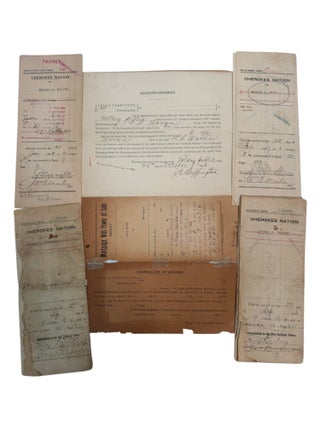
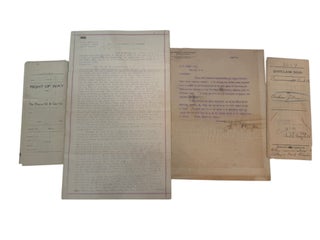
Corporate credit and Five Tribes land title archive, 1895 to 1913, documenting how mortgages, title investigation, deeds, and pipeline easements attached private capital to land within the Chickasaw and Cherokee Nations before and after Oklahoma statehood. A 1906 farm loan letter seeks Dawes Commission evidence of the Grayson family’s “blood” and roll numbers before accepting an abstract beginning with an allotment deed. The remaining instruments place commercial buildings, rental income, acreage, and a petroleum pipeline right of way under the control of individual lenders and oil companies.Archive of four documents comprising six typed and printed leaves, Purcell and Okmulgee, Indian Territory, and Muskogee and Washington County, Oklahoma, 1895 to 1913.
[1] Brown, George W.; Trudgeon, W. H. F. Agreement and Mortgage. Purcell, Chickasaw Nation, Indian Territory, May 15, 1895. Three typewritten pages. Brown mortgages commercial property on the south side of Main Street in Purcell to Trudgeon after borrowing $2,010 and obtaining his participation as surety on additional promissory notes. The security includes portions of Lots 2, 3, and 4 in Block 8, the Houghton brick building, the Brown Opera House, party walls, and another parcel with an icehouse. Trudgeon receives possession as trustee, with authority to collect rents, insure the buildings against fire, tornado, and lightning, pay obligations from the rental fund, sell the property after default, collect a two percent commission, and permit Brown ninety days to redeem after a sale.
[2] Hopping & Kennedy. Typed letter signed to J. C. Snook & Co. Okmulgee, Indian Territory, May 21, 1906. One page on Hopping & Kennedy Farm Loans letterhead. The firm discusses certificates, a sample title abstract, and forms “starting from the allotment deed,” then reports, “I have written the Dawes Commission as to the blood of the Graysons, however, Mr. Clapp has not given me the Roll number of any of them.” The writer adds that Clapp “is not going to be satisfied with our Indian Roll but will have to go to the records which is the safest way,” recording how a private lender tested an allottee family’s legal capacity to mortgage or convey land through federally approved rolls and blood classification
[3] Commonwealth Trust Company. Quitclaim Deed to Andrew J. Crow. Muskogee, Oklahoma, July 27, 1908. One printed and typewritten leaf with signatures, notarial acknowledgment, and embossed corporate seal. For $100, the company conveys 44.92 acres in Washington County, comprising the east half of the east half of the southeast quarter, less 5.08 acres occupied by the K. O. C. & S. Railroad right of way, and the southwest quarter of the southeast quarter of the southeast quarter of Section 14, Township 23 North, Range 13 East. The form identifies the grantor as a corporation organized under federal law and is executed by president J. P. Allen and secretary L. B. Beard.
[4] Prairie Oil and Gas Company. Right of Way. Washington County, Oklahoma, May 29, 1913. One printed and manuscript leaf concerning land in Section 14, Township 23 North, Range 13 East. In return for $14.30, the grantors authorize Prairie Oil and Gas to lay, maintain, operate, and remove a pipeline, enter and leave the property, change pipe size, and install an additional parallel line upon payment of equivalent consideration. A manuscript clause requires the company “to bury the said line on above described land, at least 12 beneath the surface,” while the printed terms place unresolved damage claims before three arbitrators.
The 1895 mortgage predates allotment of the Chickasaw Nation and encumbers buildings and rents in Purcell, a railroad town established on Chickasaw land. Congress altered the mortgage and conveyance market with the Act of April 26, 1906, which barred full blood citizens of the Five Tribes from alienating or encumbering allotted land for twenty five years and made the federally approved rolls determinative of blood quantum. Hopping & Kennedy wrote less than a month after that statute became law, making its inquiry into the Graysons’ “blood” and roll numbers a contemporaneous response to the new restriction. The Act of May 27, 1908 then removed restrictions from specified classes of allottees according to age and recorded degree of Indian blood; the Commonwealth Trust deed is dated July 27, immediately after the statute’s sixty day implementation period. By 1913, Prairie Oil and Gas, a Standard Oil affiliate operating gathering and interstate trunk lines, was acquiring inexpensive pipeline corridors across Washington County parcels created through the Cherokee allotment system. Moderate to pronounced toning, folds, stains, edge wear, chips, and localized losses; the mortgage retains an early metal fastener and the corporate deed retains its embossed seal. Text and signatures remain substantially legible. Overall good condition. A documentary sequence of federal racial classification, private lending, corporate title, and petroleum infrastructure operating upon Chickasaw and Cherokee lands during allotment and early Oklahoma statehood.
Item #23861
Price: $1,200.00
See all items in Industrialization, Manufacturing, and Infrastructure, Urbanization & City Development, Oklahoma, Native American, Environment & Resources
See all items in American History & Americana, American History by State, Indigenous Peoples, Labor, Environment & Industry
See all items by Chickasaw Cherokee Land Development
See all items in Oklahoma
Suggested Native AmericanBrowse All




Suggested Industrialization, Manufacturing, and InfrastructureBrowse All


Suggested OklahomaBrowse All


Suggested Indigenous PeoplesBrowse All