Victory over Japan Parade in Honolulu,an American Serviceman’s 129 Photographs of Hawaiʻi, 1945
Photograph
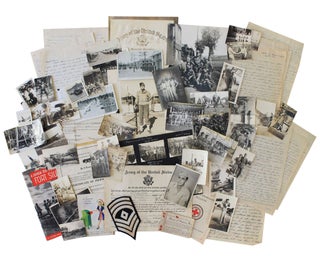
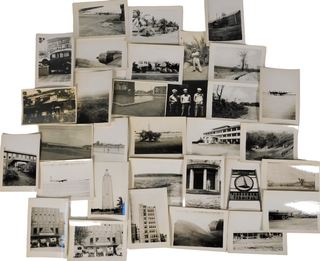
American Army serviceman’s photograph archive from time stationed in Hawaiʻi, 1945, documenting military service, civilian Honolulu, and the end of the Pacific War from the personal perspective of a soldier stationed on Oʻahu. The compiler photographed his barracks, fellow soldiers, weapons training, local and daily life. His travel between Honolulu, Waikiki, ʻEwa, and other parts of the island are documented through unique photographs of public venues, streets, women and hula performances, local residents, railroads, and agricultural districts. The archive consists extensive handwritten captions which record how an American serviceman understood the people and places around him, largely through an imperial framework. A substantial Victory Over Japan Day sequence, which shows enormous crowds in downtown Honolulu, WACs marching, Army vehicles and artillery, rooftop spectators, and a military group that the compiler identifies as “the famous 100th battalion from Hawaii composed of Japanese American citizens.”Photo archive of 129 gelatin silver photographs, each approximately 2 x 2.5 inches, Hawaiʻi, 1945, mounted to unbound album leaves, with two contemporary newspaper clippings. The military photographs show soldiers drilling with rifles, practicing with bayonets, posing with their weapons, group formations, and relaxing on barracks roofs. Several men are identified by name, including Parker and Campbell, and the photo archive owner appears himself in photographs. The VJ Day photographs form one of the strongest sequences in the archive. One caption reads, “This will give you some idea of the crowd in Honolulu on V.J. Day. Notice the servicemen almost outnumber the civilians.” Other photographs show “The W.A.C.s on parade,” military convoys, large artillery pieces, spectators packed onto sidewalks and roofs, and the unit identified by the compiler as the 100th Battalion. His captions also record his understanding of Hawaiʻi’s population. He writes that “most of the civilian population are either Oriental or Hawaiian,” calls a hula performance “a dancing ceremony held by the natives,” describes another photograph as “some of the natives posing in front of their huts,” and captions a souvenir stand “one of many curio shops with all the handicraft of the natives and different souvenirs.” Women receive repeated attention. The compiler photographs hula performers, women in leis and grass skirts, women in swimwear, street encounters, and a topless woman posing outdoors; beneath one candid Honolulu photograph he writes, “Note?! The girl!!” These images place the attitudes of a young male serviceman directly into the record and document the way he treated local culture and women as subjects of curiosity, recreation, and sexual attention.
Hawaiʻi was an American territory in 1945, and Oʻahu was a major United States military center before the attack on Pearl Harbor. The war greatly expanded the military presence on the island and placed civilian life under military control. Martial law began after the December 7, 1941 attack and ended on October 24, 1944, so these photographs record Hawaiʻi during the first year after formal martial law ended but before wartime military activity had disappeared. National Park Service The album’s reference to the 100th Infantry Battalion adds another layer to the Honolulu parade sequence. The Army activated the all Nisei 100th Infantry Battalion in Hawaiʻi in June 1942, after Japanese American soldiers in Hawaiʻi had faced suspicion and exclusion from military service; men of the 100th later fought in Europe and became associated with the 442nd Regimental Combat Team. National Park Service The compiler’s identification of a parade contingent as the 100th should therefore be treated as his contemporary attribution rather than a confirmed unit identification, since the battalion itself was serving in Europe in 1945. Captions reveal that the author recognizes Japanese American soldiers as American citizens while elsewhere classifying Honolulu civilians by race. His photographs of hula, souvenir stands, women, tropical scenery, and local residents show how military service and tourism overlapped for American servicemen stationed in the islands. Unbound album leaves are brittle, chipped, torn, and substantially deteriorated at the margins, though the handwritten captions remain largely legible; photographs are generally in very good condition with occasional slight silvering.
Item #23940
Price: $550.00
See all items in Hawaii, World Indigenous Peoples, World Culture & Travel, World Indigenous Peoples, Imperialism & Colonialism, World War II
See all items in American History by State, Indigenous Peoples, International & Global Culture, Military & War
See all items by Wartime Honolulu Photo Archive
See all items in Hawaii
Suggested World War IIBrowse All



Suggested World Indigenous PeoplesBrowse All




Suggested HawaiiBrowse All




Suggested Indigenous PeoplesBrowse All