American Indian Wars History, Philadelphia Newspaper Reporting Custards Death at Little Bighorn, 1876
Periodical
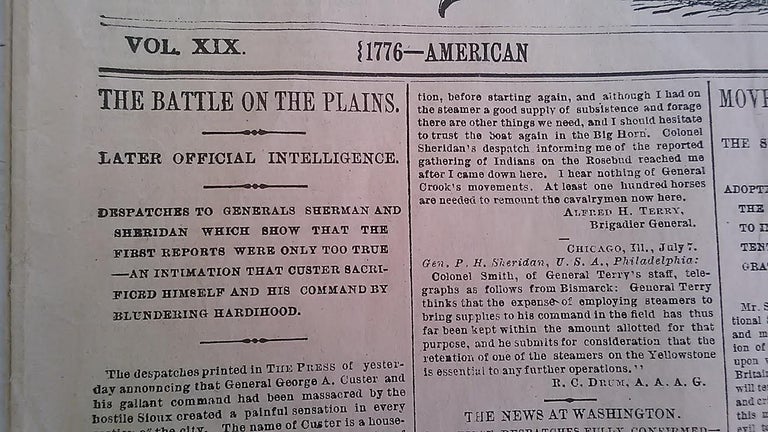
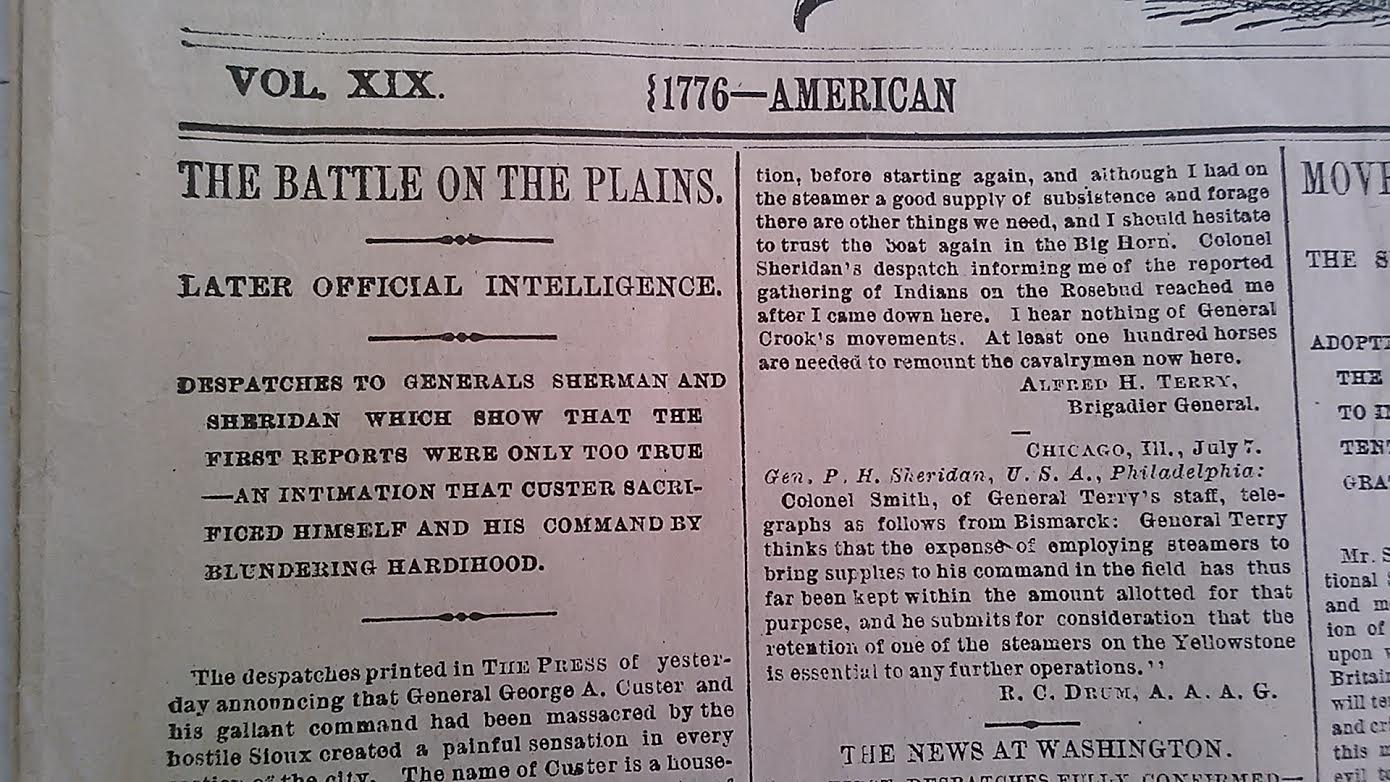
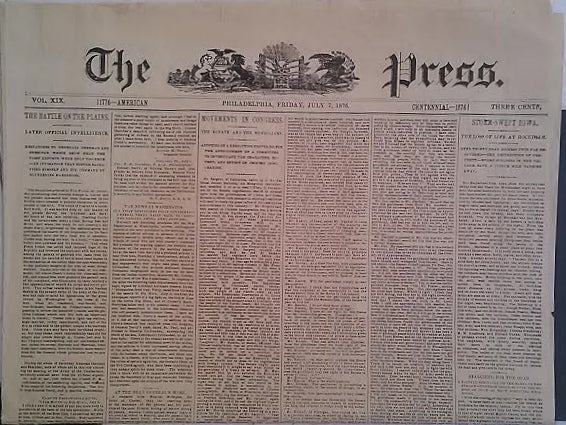
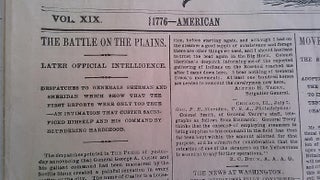
The Press, July 7, 1876, is a Philadelphia newspaper issue preserving early Eastern reporting on the Battle of the Little Bighorn and the death of George Armstrong Custer, one of the most widely mythologized military defeats of the American Indian Wars. The issue appeared less than two weeks after the June 25 to 26, 1876 battle along the Little Bighorn River, where Lakota, Northern Cheyenne, and Arapaho warriors fought the U.S. Army’s 7th Cavalry in south-central Montana. Its front-page account is significant as a contemporary record of how Custer’s death was immediately framed for urban newspaper readers during the nation’s Centennial summer, emphasizing sacrifice, military honor, and shock rather than the Indigenous defense of land and sovereignty now central to historical interpretation.The Press. Philadelphia, Pennsylvania. July 7, 1876. Four pages present, comprising pages 1, 2, 7, and 8 only. The front page is dominated by war-related reporting, with the lead story addressing dispatches to Generals William T. Sherman and Philip Sheridan and stating that the first reports of Custer’s defeat were “only too true.” The article suggests “Custer sacrificed himself and his command by blundering hardihood,” while also elevating him in memorial language: “The name Custer is a household word,” and “Custer fell—fell at the head of his command; fell where Death’s sickle cut close and sure.” The surviving front-page spread offers a concentrated example of immediate post-battle newspaper rhetoric, combining battlefield uncertainty, military chain-of-command reporting, and heroic commemoration before later national mythologies of “Custer’s Last Stand” had fully hardened.
The issue’s timing gives it research value for the study of Reconstruction-era print culture, U.S. military expansion, Indigenous resistance, and the formation of public memory around the Plains Wars. As a Philadelphia paper published days after the battle became national news, it shows how eastern readers encountered the event through telegraphic dispatches and editorialized martial language during a year otherwise dominated by Centennial commemoration. Incomplete, with only pages 1, 2, 7, and 8 present; slight wear and small tears around edges; otherwise well preserved, very good. A strong contemporary newspaper survival centered on the first wave of public reaction to Custer’s defeat and the national reframing of Little Bighorn in the summer of 1876.
Item #14379
Price: $450.00
See all items in Western Americana, Other (American History), Wyoming, Native American
See all items in American History & Americana, American History by State, Indigenous Peoples, Military & War
See all items by Western Americana General Custer
See all items in Philadelphia, Wyoming
Suggested Western AmericanaBrowse All


Suggested Native AmericanBrowse All




Suggested Other (American History)Browse All






Suggested WyomingBrowse All