Postwar Petroleum Industry and Labor Photo Archive, Oil Refineries in California & Michigan, 1945-1946
Photograph
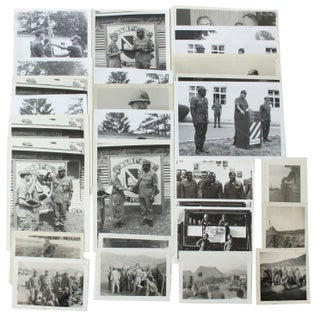
Oil refinery photo archive documenting refinery labor, plant operations, and worker identity at Kern Oil in Southern California and Mid West Refineries in Grand Rapids, Michigan in the immediate postwar years, showing how petroleum production expanded through the daily work of identified laborers during the industrial reorganization that followed World War II. The group centers on the men who stood on the ground among cracking towers, tank farms, piping runs, shop buildings, and control areas. Postwar oil demand rose with civilian automobile use, trucking, suburban growth, and military-industrial continuity, and refineries became key sites where that expansion was made practical through skilled and semi-skilled labor, shift work, maintenance, inspection, and dangerous physical proximity to heat, pressure, fuel storage, and heavy equipment. The archive records that system at worker level, where industrial growth appears as crews posing beside process units, inside service spaces, and at small plant structures rather than as abstract production statistics.Photo archive of 26 silver gelatin photographs, each 2.5" x 4.5", Kern Oil, Southern California, and Mid West Refineries, Grand Rapids, Michigan circa 1945-1949. Roughly half the images show refinery infrastructure with dense fields of distillation columns and stacks, cylindrical tanks, elevated piping, steel frameworks, service roads, and storage areas; one dramatic view shows a damaged or collapsed horizontal tank or vessel within a twisted metal structure. A large painted sign reading “MID-WEST REFINERIES INC.” advertises “GASOLINES / FUEL OILS / BURNER OILS / KEROSENE.” Other views show broader plant grounds with horizontal storage tanks, outbuildings, and open yards. The remaining photographs focus on workers posed alone and in groups in overalls, work shirts, caps, and brimmed hats, standing beside towers, near pipe runs, outside small office or shack structures, and in work areas with process equipment visible behind them. Several versos identify individuals by name, including groupings such as “Perry / Bob Patter / Lou Lane / John Higdon,” “Charles Johnson / Bart Klein / 1946,” “B. Klein / C. West / D. Golden,” one inscription reads “4-15-49 / Place / MAX WERTZ SHACK / M-50 / Lou Peterson.”
American oil refining in the mid-1940s stood at the junction of wartime production and postwar consumer expansion. Plants that had helped sustain military logistics now fed the fuel economy that depended on workers whose labor was physically demanding and hazardous. These photographs preserve the named men occupying the industrial landscape that structured their livelihoods. Light wear and minor curling; numerous versos with identifying inscriptions; overall very good condition. A grounded postwar labor archive that places refinery workers inside the machinery of American oil production at the moment petroleum became central to everyday life.
Item #23241
Price: $450.00
See all items in California, Michigan, Environment & Resources, Industrialization, Manufacturing, and Infrastructure, Military & War Photography
See all items in American History by State, Labor, Environment & Industry, Photography
See all items by Oil Refinery Industrialism
See all items in California, Michigan
Suggested Industrialization, Manufacturing, and InfrastructureBrowse All


Suggested CaliforniaBrowse All






Suggested MichiganBrowse All



Suggested PhotographyBrowse All