WWII Pacific Theater U.S. Occupation in the Philippines and Admiralty Islands, 1944-1945
Photograph
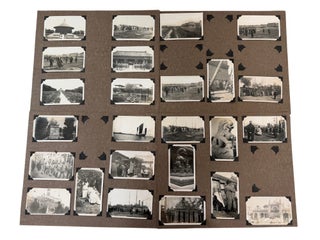
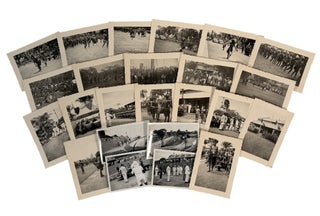
[WWII] [Indigenous Peoples] U.S. soldier photographs recording military occupation, transport, and daily movement across the Admiralty Islands, Samar, and the Philippines during World War II and its immediate aftermath, establishing how American forces operated through island bases, coastal landings, aircraft facilities, and encounters with local indigenous communities. Made and retained by an unidentified American serviceman, the group follows the circulation of personnel through several linked wartime zones rather than a single camp, with local captions on the versos anchoring parts of the sequence to “Admiralty Islands,” “Samar Island,” and the “Philippines.” This archive showcases soldiers posed at encampments and beside aircraft, landing craft and small boats, military vehicles moved through settlements, and photographs of Indigenous and Filipino civilians showing the human landscape through which U.S. forces advanced, occupied, and remained into the surrender period.Photo archive of 45 likely silver gelatin photographs, ranging from 2.5 x 3 to 3.5 x 5.75 inches, Admiralty Islands, Samar, and the Philippines, circa 1944 to 1945. Numerous versos carry manuscript identifications including “on Admiralty Islands,” “Natives on admiralty Islands,” “Samar Island,” “Samar Philippines,” “Philippine,” and “chapel in philippines,” while several prints bear circular “Passed by Naval Censor” stamps and one caption reads “Jap bomber (Betty) Sept. 1945 Samar,” fixing at least one portion of the group to the post surrender occupation moment. The images include shirtless American servicemen posed in palm lined camps, group portraits outside Quonset huts or temporary structures, a parked twin engine military aircraft, a beached or near shore vessel, soldiers gathered around tables and equipment, and an Asian soldier who looks to possibly be in Japanese uniform, standing in front a monument. Many photos show the local community with views of thatched buildings, colonial era religious structures, village crowds, market or street scenes, women and children gathered before huts, and several close portraits of Indigenous islanders.
The photographs belong to the final phase of the Pacific war, when the Admiralty Islands served as a major Allied base complex after the 1944 campaign and Samar remained part of the wider Philippine theater retaken from Japanese control and held through the end of the war. This on the ground perspective shows how soldiers' photos moved through censorship channels, recorded the built infrastructure of island warfare, and fixed the asymmetrical encounter between U.S. servicemen and local populations. Minor surface and edgewear, album glue residue en verso, images remain clear and writing legible; overall very good condition. The combination of location notes, naval censor stamps, aircraft and coastal transport scenes, and sustained views of local communities offer a raw visual representation of American military presence across the Southwest Pacific.
Item #23179
Price: $885.00
See all items in World Indigenous Peoples, World Indigenous Peoples, World War II, Philippines
See all items in Indigenous Peoples, International & Global Culture, Military & War, World History by Geography, Archive
See all items by Pacific Theater
See all items in Philippines, Admiralty Islands
Suggested World War IIBrowse All





Suggested PhilippinesBrowse All




Suggested World Indigenous PeoplesBrowse All




Suggested World History by GeographyBrowse All