Stanford School of Engineering Photo Archive with Identified Faculty and Students, 1930-50s
Photograph
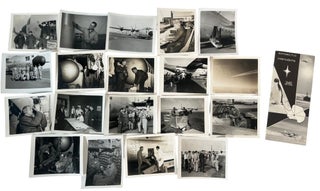
Stanford University Military Engineering Archive Documenting the First Army Ordnance Reserve Gauging Program, ca. 1930. Stanford University photo archive documenting the emergence of interwar military-industrial technical education, ordnance gauging instruction, and precision engineering research on campus during the early development of Stanford’s engineering and applied science programs. Rather than depicting science classrooms in a general sense, these photographs specifically document the technical culture surrounding Army ordnance training, instrumentation systems, machine calibration, and laboratory-based engineering instruction that linked universities to the expanding infrastructure of American military preparedness between World War I and World War II. Taken together, the archive captures Stanford at the moment when higher education increasingly merged scientific research, industrial precision manufacturing, and military technical training into a unified research model that later shaped the wartime and Cold War defense university system.Photo archive of 11 large silver gelatin photographs, each approximately 8" x 10", Stanford University, California, dating from 1930 into the 1950s; two later views mounted to decorative yellow board. Several photographs depict laboratory interiors filled with precision instrumentation, gauging apparatus, optical and mechanical measuring devices, machine-tool equipment, calibration benches, microscopes, drafting stations, and technical worktables arranged for instruction and inspection work. One especially important close-up photograph shows a large precision gauging or rotational calibration apparatus associated with ordnance measurement and machine tolerance testing. Surrounding the device are machined cylindrical components, threaded fittings, gauge rings, and polished metal parts likely used in dimensional inspection, bore alignment, concentricity testing, or interchangeable manufacturing instruction. Another darkened workshop view depicts what appears to be a heavy precision lathe or gauging bench fitted with a mounted cylindrical test component, equipment consistent with ordnance inspection and military engineering instruction during the interwar period. Additional photographs show groups of students and instructors posed around technical apparatus inside instrumentation laboratories, while later mounted photographs document more formalized postwar engineering office and drafting environments associated with large-scale technical administration and research organization.
Most important is a detailed handwritten verso inscription reading: “Equipment used Feb 1930 Ordnance School at Stanford University. This was first time a course in gauging was given in any Army Ordnance Reserve Unit (permanent facilities excepted). Instructor; Lieut Merrill S. Hingo. Photo; Lieut Howard Story Taylor.” The inscription firmly identifies the archive as documentation of early Army ordnance reserve technical instruction conducted at Stanford and specifically ties the machinery to military gauging education. In the 1920s-30s, “gauging” referred not merely to ordinary measurement but to the specialized science of precision dimensional inspection used in artillery manufacture, weapons-part standardization, shell tolerances, bore measurement, interchangeable machining systems, and industrial calibration. Such instruction formed a critical component of modern military-industrial production, where even minor deviations in machining tolerances could affect artillery accuracy, chamber pressure, shell seating, or mechanical reliability.
Several outdoor group portraits further reinforce the military context. One large group stands beneath a doorway marked “Military Science and Tactics,” while another includes Colonel Donald C. Cubbison, a career U.S. Army officer and West Point graduate who served as professor of military science and tactics at Stanford from 1930 to 1935 before later attaining the rank of major general during World War II. His appearance situates the archive directly within Stanford’s interwar military training system and links the photographs to broader national efforts to train technically educated reserve officers in engineering, ordnance, artillery science, and industrial preparedness.
The archive also reflects Stanford’s broader transformation into a modern research university centered on applied science and engineering. During the interwar years, Stanford’s scientific departments expanded laboratory instruction, instrumentation programs, and research-based technical education under faculty including Robert E. Swain, John P. Mitchell, William H. Sloan, and George S. Parks. Parks in particular became associated with analytical chemistry and geochemical laboratory science, disciplines heavily dependent upon precision instrumentation and calibrated measurement systems. The engineering and laboratory culture documented here overlaps with contemporary developments in industrial metrology, applied physics, materials testing, optical measurement, and machine-tool inspection that increasingly tied university research to industrial production and military logistics.
What makes the archive especially significant is the way it documents the transitional infrastructure between traditional university instruction and the emerging defense-oriented research university model. These photographs preserve not simply classrooms, but the physical systems of technical education itself: calibration benches, inspection machinery, gauging apparatus, optical instruments, drafting rooms, and laboratory spaces where students and reserve officers were trained in the precision engineering practices underlying twentieth-century industrial warfare and mass manufacturing. In doing so, the archive visually traces the early foundations of the university-based defense engineering culture that would later expand dramatically during World War II and the Cold War throughout California research institutions and the broader military-industrial complex.
Photographs are sharp and highly detailed, with clear views of equipment and interiors; handwritten identifications remain legible. The two mounted 1950s photographs have several large tears without image loss, with lighter handling wear elsewhere. Overall good condition.
Item #23256
Price: $2,500.00
See all items in Other (American History), California, Other (Military), Technology, Engineering & Innovation
See all items in American History & Americana, American History by State, Military & War, Science, Medicine & Technology, Archive
See all items by Stanford University School of Engineering
See all items in California
Suggested Other (Military)Browse All



Suggested Other (American History)Browse All

Suggested CaliforniaBrowse All






Suggested ArchiveBrowse All