NAACP and Jim Crow Legal Battle on Lynching, Federal Civil Rights Policy, and Racial Terror
Archive
Civil rights political pamphlet archive documenting competing national and Southern responses to lynching, racial violence, and federal civil rights intervention during the immediate post–World War II period. Issued between 1946 and 1951, the publications capture a formative moment in the political struggle over civil rights legislation, federal authority, and racial segregation in the United States. The texts present direct documentary opposition between segregationist political leadership in South Carolina and national labor and civil rights organizations advocating federal protection against racial discrimination and violence. J. Strom Thurmond and James F. Byrnes articulate elite Southern resistance to anti-lynching legislation and federal civil rights enforcement, while the Congress of Industrial Organizations and the National Association for the Advancement of Colored People present detailed critiques of racial terror, employment discrimination, and systemic inequality. Together the materials situate postwar civil rights debate within the broader national reckoning over democracy and racial equality following the war.Archive comprises four staple-bound pamphlets issued between 1946 and 1951 in Washington, D.C., New York, and Columbia, South Carolina. Pamphlets range from approximately 4 to 16 pages and measure about 5 x 7.5 inches to 6 x 9 inches. Contents are as follows:
[1] Congress of Industrial Organizations. Report of the National CIO Committee to Abolish Discrimination. Washington, D.C.: Congress of Industrial Organizations, November 1946. This report outlines postwar labor movement initiatives confronting discrimination in employment, housing, and education, with particular emphasis on African American civil rights and racial violence. It references two lynchings and the destruction of a Black community in Columbia, Tennessee, concluding that “It is the problem of all the people who have bought freedom at inflation prices—with the lives of over 250,000 Americans… if the victory in battle is to become a truly people’s victory.”
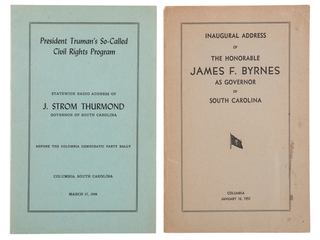
[2] Thurmond, J. Strom. President Truman’s So-Called Civil Rights Program. Columbia, SC: Columbia Democratic Party, 1948. Text of a statewide radio address delivered during the controversy surrounding President Harry Truman’s civil rights proposals. Thurmond condemns federal civil rights legislation, particularly anti-lynching measures, as unconstitutional intrusions upon states’ rights, asserting that “The proposed law is unnecessary because enlightened public opinion has virtually stamped out this crime,” and warning that federal authority would “intrude itself into every phase of the daily lives of our people.”
[3] National Association for the Advancement of Colored People. A Chance to Live. [New York]: NAACP, circa 1949. Pamphlet presenting case-based documentation of racial discrimination and violence. The cover lists approximately 400 names of individuals identified as victims of racial bias, while interior pages recount incidents of assault and murder, frequently attributed to Ku Klux Klan members or other white vigilantes, framing racial terror as an urgent national crisis requiring federal response.
[4] Byrnes, James F. Inaugural Address of the Honorable James F. Byrnes as Governor of South Carolina. Columbia, SC: 1951. Byrnes condemns mob violence in general terms while advocating local control and “law and order.” The address rejects both the Ku Klux Klan and the NAACP while reaffirming the doctrine of “separate but equal,” presented as the stated preference of Black South Carolinians and as justification for resisting federal intervention.
Issued during the years preceding the Supreme Court’s 1954 decision in Brown v. Board of Education, these pamphlets document the ideological struggle over federal civil rights enforcement in the Jim Crow South. The period witnessed escalating conflict between national organizations seeking federal protections against racial violence and Southern political leaders committed to preserving segregation through appeals to states’ rights and constitutional autonomy. Light toning, minor edge wear, and staple oxidation consistent with mid-twentieth-century political ephemera; one pamphlet with mild foxing. Text throughout remains clear and fully legible. Overall very good condition. Cohesive printed documentation of early Cold War civil rights debate and Southern political resistance to federal reform.
Item #17767
Price: $1,450.00
See all items in Civil Rights Movement, Reconstruction & Jim Crow, New York, Civil Rights Movement, Reconstruction & Jim Crow, Law & Public Policy
See all items in African American History, American History by State, Civil Rights, Law, Incarceration & Public Policy
See all items by Civil Rights Legislation
See all items in South Carolina; Washington D.C; New York
Suggested Civil Rights MovementBrowse All




Suggested Reconstruction & Jim CrowBrowse All




Suggested Law & Public PolicyBrowse All




Suggested New YorkBrowse All