


Allied Technical Intelligence and Captured German Aeronautical Research: JIOA Interrogation Report CGD 500, 1946
Pamphlet
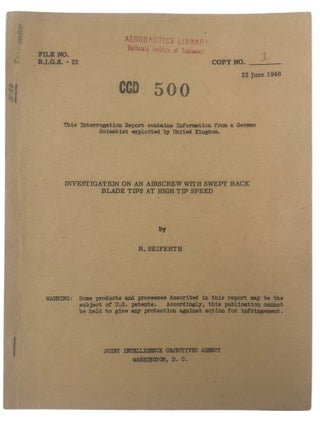
German aeronautical research on swept-back airscrew blade design, 1946, documenting the Allied technical intelligence program that captured, translated, and rapidly disseminated advanced German aviation research immediately following the Second World War. Prepared from work conducted at the British Ministry of Aircraft Production (M.A.P.), Völkenrode, and originating in research begun under the renowned aerodynamicist Albert Betz at Göttingen, the report examines swept-back propeller blade tips operating at extremely high rotational speeds as German engineers sought solutions to compressibility effects encountered as aircraft approached the speed of sound.R. Seiferth's Investigation on an Airscrew with Swept Back Blade Tips at High Tip Speed, a draft translation dated April 1, 1946, issued by the Joint Intelligence Objectives Agency as CGD 500 on 22 June 1946. Reports and Translations. 10 × 8 inches. Six leaves, stapled. The title page identifies the work as a translation prepared at M.A.P. Völkenrode, while the printed JIOA wrapper states, "This Interrogation Report contains Information from a German Scientist exploited by United States." The report summarizes experimental investigations into swept-back airscrew geometry at high tip speeds, discussing aerodynamic efficiency, compressibility effects, and comparative testing. The front wrapper bears the manuscript notation "500 Seiferth" and the ownership stamp of the California Institute of Technology Aeronautics Library, preserving the provenance of this copy within one of America's leading postwar centers of aeronautical research. Light handling wear; original staples intact; library stamp and manuscript notation to front wrapper. Overall good condition.
Although focused on propeller aerodynamics rather than the turbojet itself, the report examines many of the same high-speed airflow problems that confronted the emerging jet age, including shock-wave formation, compressibility, aerodynamic efficiency, and transonic flight. It presents experimental investigations into swept-back airscrew geometry at high tip speeds and comparative testing within the broader body of German aerodynamic research that proved invaluable to Allied aircraft designers developing the first generation of practical jet aircraft, turboprop engines, and high-speed military aviation after 1945.
By the end of the war, Germany possessed the world's most advanced operational jet aircraft, including the Messerschmitt Me 262 fighter and Arado Ar 234 jet bomber, while German scientists were conducting extensive research into swept wings, high-speed aerodynamics, and propulsion concepts that were years ahead of most Allied programs. Recognizing the extraordinary military and scientific value of this work, Allied technical intelligence teams immediately secured German laboratories, interrogated leading engineers, and translated thousands of reports before the information could be lost. Issued by the Joint Intelligence Objectives Agency as CGD 500 on 22 June 1946, Seiferth's report formed part of that remarkable series of intelligence publications that transferred German wartime aeronautical knowledge into American and British research establishments, accelerating the development of the first generation of postwar jet-powered aircraft.
Item #23602
Price: $1,850.00
See all items in World War II, Science, Technology, Engineering & Innovation, Aviation, Europe
See all items in Military & War, Science, Medicine & Technology, Space & Aviation, World History by Geography
See all items by Captured German Aviation Research
Suggested World War IIBrowse All





Suggested AviationBrowse All



Suggested ScienceBrowse All



Suggested EuropeBrowse All





![Truffaut’s Baisers Voles [Stolen Kisses] Vintage Original Film Pressbook. Francois Truffaut.](https://maxrambod.cdn.bibliopolis.com/pictures/16688.jpg?width=320&height=427&fit=bounds&auto=webp&v=1665096220)