The Dawn of American Jet Aviation: A Military Mechanic’s Album of 205 Photographs Documenting the P-80 Shooting Star, F-86 Sabre, German V-1 Rocket Technology, and Early Military Integration, 1948–1949
Archive
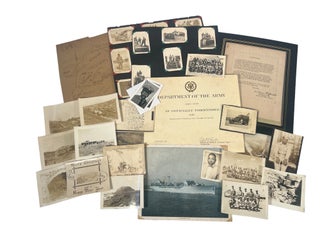
America’s first operational jet fighter, the Lockheed P-80/F-80 Shooting Star, anchors this substantial photograph album documenting the transition to jet airpower and integrated mechanics training at Chanute Air Base, Illinois, in 1948–1949. Compiled by Sgt. Robert Lee Richardson, the album records the specialized technical work that brought this pioneering fighter into sustained military service. Photographs of an F-86 Sabre and a swastika-marked flying bomb connect American aviation to the exploitation of German wartime research: the Sabre’s swept-wing design drew on captured German aerodynamic data, while the bomb, captioned “Henry Ford’s Buzz Bomb,” is likely a Republic-Ford JB-2, an American copy of the German V-1 developed through reverse engineering. These images document aircraft and weapons through which American engineers adapted wartime advances to postwar military requirements. Aircraft nose art and a captioned street scene in occupied Japan broaden the album’s coverage to servicemen’s visual culture and civilian life under occupation.Photo album containing 205 silver gelatin photographs dated May 1948–October 1949, mounted with black photo corners on annotated leaves, accompanied by military certificates and other ephemera. Mechanics work around exposed engines, begin an engine change, and prepare jets for engine run-ups. Several views show personnel beside a V-1-type pulsejet flying bomb, including one captioned “Jim Gamble and Henry Ford’s Buzz Bomb.” Nose art receives particular attention through a close-up captioned “Shark Nose,” the cartoon cats of “Pussy Mission,” and repeated views of decorated jet fuselages. A photograph captioned “One of the modern streets in Japan,” dated February 1949, depicts residents and children along an unpaved street during the Allied occupation. A September 1948 Chanute jet mechanics graduation portrait shows Black and white servicemen together; another records instrument specialist graduation in May 1949. Accompanying material includes three proficiency certificates naming Richardson, “Flying Safety” for March 1949, and a squadron Christmas menu. A consular telegram reports the discovery in Tijuana of a body identified from accompanying documents as Robert Lee Richardson.
The album documents the technical training and daily maintenance work that supported America’s first generation of operational jet fighters, alongside the presence of German-designed flying-bomb technology in a postwar training hangar. Aircraft nose art preserves servicemen’s humor and visual culture, while the occupied Japan street scene records civilian life under Allied occupation. The September 1948 class portrait places Black and white mechanics together during the early desegregation of the armed forces. Dated captions connect these developments to named personnel and specific maintenance activities. Album leaves toned with edge wear; scattered photographs show scratches, creases, and minor edge damage. Detailed handwritten captions preserve aircraft terminology, colleagues’ names, and observations about mechanical failures and daily work. Brown album decorated with Army Air Forces insignia. Leaves toned with edge wear; scattered photographs show scratches, creases, and minor edge damage, with most images retaining clear detail.
Item #24076
Price: $885.00
See all items in Vietnam War, World War II, Aviation, Japan
See all items in Military & War, Space & Aviation, World History by Geography
Suggested AviationBrowse All





Suggested World War IIBrowse All




Suggested Vietnam WarBrowse All


Suggested JapanBrowse All