African American Religious and Spiritual Community Archive: Black Churches, Gospel Music, Mutual Aid & Advocacy, 1943–1973
Archive
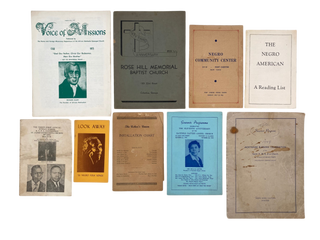
African American religious and spiritual community archive, 1943 to 1973, documenting religious organizations, gospel music, and denominational advocacy across the U.S., many associated with the African Methodist Episcopal Church. The earliest materials include a 1943 Negro Community Center program in partnership with the Port Chester Jewish Center in New York; an annotated 1945 Louisiana usher’s union chart for Black Baptist congregations; and a Chicago gospel chorus anniversary program documenting performances organized under Eula M. Carter. Later publications include a 1957 National Council of Churches bibliography of recommended reading prepared in response to school desegregation and a 1973 A.M.E. missionary periodical addressing Black liberation, overseas development, American politics, and denominational work in Africa and the Caribbean.Archive of nine original booklets and programs, New York, Louisiana, Illinois, Pennsylvania, Georgia, Ohio, and New York, 1943 to 1973. Archive includes:
[1] Negro Community Center. Rye · Port Chester, New York. Port Chester Jewish Center, July 25, 1943. Program for a wartime community center initiative whose opening proposition declares that “every civic and right thinking citizen should feel a sense of responsibility for the general welfare of its less privileged boys and girls.” Its organizers connect their project directly to wartime conditions, arguing that employment “in war plants and other fields” had deprived young people of parental guidance and calling for “adequate, wholesome recreation facilities.”
[2] The Usher’s Union. Installation Chart. [Shreveport, Louisiana], 1945. Four page circular recording the officers and 1945 visitation schedule of an ushers’ association serving Black congregations in the Shreveport and Bossier City area. The calendar mentions Zion Baptist Church and visits to dozens of congregations including Shiloh, Mt. Canaan, St. Matthew A.M.E., C.M.E. Temple, Mt. Moriah, Baptist Temple, Samuel Chapel, First Baptist, and Antioch in Bossier City. Contemporary ink and pencil additions record further appointments including Good Hope, Pleasant Hill, Pleasant Grove, Jewel, Stonewall, and Zion Mission, while an ownership inscription on the cover reads “Sunflower F. H. King Pres.”
[3] Souvenir Programme Celebrating the Eleventh Anniversary of the Rayfield Baptist Gospel Chorus. Chicago: Rayfield Baptist Church, October 22 to 28, 1945. Anniversary program centered on Mrs. Eula M. Carter, president of the Rayfield Gospel Chorus. Six days of programs recording Rayfield Gospel performances with Ward’s Memorial, Philadelphia, Hartzel M.E., Providence, Burning Bush, Holy Temple, Mt. Herman, St. Mary C.M.E., Highway I.C. Singers, Evening Star, Mt. Pisgah, Gideon, Mt. Zion, and Macedonian gospel choruses.
[4] Souvenir Program. Mortgage Burning Celebration of the Varick A.M.E. Zion Church. Philadelphia: Varick A.M.E. Zion Church, 1948. Illustrated history and celebration program for the congregation at 19th and Catherine Streets under Rev. Joseph Dixon Cauthen. The church history traces Varick from its organization on May 27, 1908 and recounts the acquisition of its Philadelphia properties, Depression era financial difficulties, its “Mortgage Crusade,” and Cauthen’s arrival in 1941. The celebration brought visiting ministers from Baptist, A.M.E., A.M.E. Zion, Methodist, and Church of God in Christ congregations into a two week event ending with the mortgage burning ceremonies and a Victory Banquet.
[5] The Thirty First Annual Sunday School H.Y.P.U. Convention, St. James Overcoming Church of God. Dalton, Georgia, June 21 to 24, [ca. 1950]. Convention program presided over by General Superintendent Elder C. H. Ellison, with sessions devoted to Sunday School administration, youth activities, reports from auxiliaries, preaching, testimony, and a Saturday morning program on “The Duties of a Mother to the Church.” Delegates are identified from Dalton, Atlanta, East Point, Douglasville, Hogansville, Rockmart, Rome, Headland, Cleveland, Detroit, Louisville, and other communities, documenting a religious network extending beyond northern Georgia.
[6] Rose Hill Memorial Baptist Church. Sixty Third Anniversary. Columbus, Georgia, 1953. Illustrated anniversary book dedicated to Mother Rhoda Leonard on her ninety third birthday. Its congregational history dates Rose Hill to 1890 and records successive buildings, pastors, relocations, and the construction of an annex in 1949 containing Sunday School rooms, a choir and pastor’s study, and a kitchen. The publication identifies Rev. N. H. Carr as pastor and documents the congregation through extensive group views of graded Sunday School classes, adult Bible classes, four missionary circles, junior and senior choirs, church and Willing Workers clubs, the Builders Club, Boy Scout Troop 88, the Baptist Training Union, and a church membership roll.
[7] Hussey, Edith; Mary Henderson; and Barbara Marx. The Negro American: A Reading List. New York: Department of Racial and Cultural Relations, National Council of Churches of Christ in the USA, 1957. Interracial Publication Number 96. Bibliography of recommended books published through June 1956 and arranged for primary children through adult readers. Its introduction opens from the Supreme Court’s May 1954 school desegregation decision and calls for “a fundamental change in the educational pattern of a large part of the country, as well as for re-examination of racial attitudes nationally.”
[8] Look Away: 56 Negro Folk Songs. Delaware, Ohio: Cooperative Recreation Service, revised 1963. Forty eight page songbook presenting spirituals, secular songs, play songs, and work songs with musical notation, including “Let Us Break Bread Together,” “Roll, Jordan,” “Deep River,” “Balm in Gilead,” “Burden Down,” “Jacob’s Ladder,” “Cotton Needs A Pickin’,” and the track laborer’s song “Chicka hanka.” Material collected by Olive J. Williams at Dorchester Academy in McIntosh, Georgia includes “Rocks on the Mountains,” “Green Trees,” and “The Grey Goose.”
[9] Collier, John W. P., Jr., ed. Voice of Missions. Vol. LXXIX, no. 6. New York: Home and Foreign Missionary Department of the African Methodist Episcopal Church, February 1973. Issue commemorating Richard Allen while reporting on A.M.E. denominational affairs and overseas missionary work. Collier’s discussion of Allen moves directly into contemporary political questions including labor, unemployment, war in Vietnam, abortion, capital punishment, racism, poverty, and the Nixon administration. Correspondence from Lesotho, Rhodesia, Malawi, Zambia, Suriname, the Bahamas, and other mission fields records salaries, schools, church construction, and local needs.
These local programs preserve the religious and spiritual organizations which supported Black communities throughout the 20th century. These organizations provided community resources, organized events, and distributed mutual aid in the face of racial discrimination, in additional to being a spiritual resource for Black families. The National Council of Churches publication explicitly addresses desegregation and racial education, while the 1973 Voice of Missions records African Methodist Episcopal engagement with Black liberation, American public policy, and overseas projects across Africa and the Caribbean. Light to moderate toning and handling wear; Shreveport chart with contemporary manuscript annotations, edge wear, chips, and short tears; Dalton convention program with pronounced creasing, soiling, and edge wear; Varick program with extensive tide marks and staining throughout, cover wear, and manuscript notation; other booklets with scattered staining, rubbing, and minor edge wear. Overall good condition. A three decade record of African American religious and spiritual communities.
Item #23812
Price: $1,750.00
See all items in African American Family & Community Life, Civil Rights Movement, U.S. Religion & Transcendentalism, Georgia, Pennsylvania, Civil Rights Movement
See all items in African American History, American History & Americana, American History by State, Civil Rights
See all items by African American Religious Community Archive
Suggested Civil Rights MovementBrowse All




Suggested GeorgiaBrowse All




Suggested PennsylvaniaBrowse All


Suggested African American HistoryBrowse All