Berkeley Prison Reform Activist Broadside "Slave, who is it that shall free you?" Prison Organizing in the Wake of the Attica Uprising, 1972
Broadside
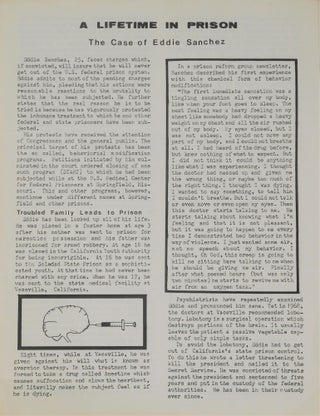
[Prison and Incarceration][Social activism] Prison reform organizing conference broadside. Attica and San Quentin prison organizing stand at the center of this January 1972 Berkeley conference broadside, which opens with a Brecht quote, “Slave, who is it that shall free you...all of us or none”, and declares that “no one in America today is more a slave than the inmates in American prisons.” The text ties prison struggle to “class and racial oppression,” names the murders at Attica and San Quentin, and frames the prison system as a site of beatings, drugs, “behavior modification,” and brain surgery schemes. The conference was held just a few months after the 1971 Attica uprising during which prisoners revolted against inhumane treatment and racial discrimination in a violent struggle that left 39 dead. The conference roster grounds the prison rights moment Bay Area Black liberation, featuring figures including Afeni Shakur, Fay Stender, and former Soledad Prison chief psychiatrist Frank Rundle.“Slave, Who Is It Shall Free You . . . All of Us or None.” The Struggle Inside. Prison Action Conference. Berkeley, 1972. Single-sheet broadside 8.5 x 11 inches, for a prison action conference scheduled for January 28-30 in Pauley Ballroom, UC Berkeley, printed on both sides. Recto features two halftone prison photographs, and a dense typed manifesto arguing that prisoner demands had moved “from traditional demands for food and shelter to demands for civil and religious rights, and finally to a general challenge to the prison system and the society which fosters it.” It announces the conference as “a forum for self education and exploration of potential action to assist the prison movement,” with key speakers Afeni Shakur, a defendant in the Panther 21 trial, Fay Stender, a Berkeley attorney with years of prison movement experience, and Frank Rundle, former chief psychiatrist at Soledad Prison. Verso gives the full three-day program: Friday evening remarks by Stender and Shakur; Saturday sessions on “Medical Repression in Prisons,” “Adult Authority and Indeterminate Sentencing,” “Economics of Prisons,” “Juvenile Reformatories and Detention,” and “Prisoners Demands”; and Sunday sessions on “Women in Prison,” “Defense of Political Prisoners,” “Military Prisons,” “Prison-Community Communications,” “Prisoners Organizations,” “County Jails and Pre-trial Detention,” plus a closing “Panel Discussion on Racism.”
The broadside illustrates the actions and intentions of the Berkeley prison movement at a time when prison rebellion, legal defense, anti-racist analysis, and ex-prisoner testimony were being brought before public audiences in the aftermath of the Attica Uprising. Afeni Shakur’s appearance links the handbill to the political world of the Black Panther movement, while the inclusion of sessions on women in prison, political prisoners, juvenile detention, county jails, and medical repression demonstrate the intersectional goals of the movement and the broadening of post-Attica activism from outrage over one massacre to a larger indictment of prison administration and criminal punishment. Some light staining; otherwise very good condition. A Bay Area prison movement piece that preserves both the rhetoric and the working program of organizing against U.S. imprisonment in the immediate aftermath of the 1971 Attica Uprising.
Item #23259
Price: $450.00
See all items in Civil Rights Movement, California, Civil Rights Movement, Prison & Prison Reform, Radical Activism, Social Activism
See all items in African American History, American History by State, Civil Rights, Law, Incarceration & Public Policy, Social Activism & Protest
See all items by Berkeley Prison Reform Conference
See all items in California
Suggested Civil Rights MovementBrowse All






Suggested Social ActivismBrowse All




Suggested Radical ActivismBrowse All


Suggested CaliforniaBrowse All