Women in Science Rutgers Microbiology Research and Streptomycin Testing, 1940s to 1950s
Photograph
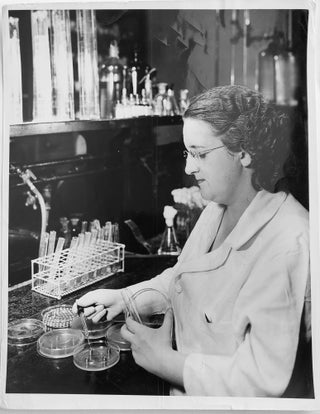
Woman microbiologist testing streptomycin at Rutgers University, undated but circa 1940s–1950s, documents laboratory work associated with one of the major developments in twentieth-century antibiotic research and records a woman working as a member of Rutgers' microbiology research staff. Streptomycin was discovered at Rutgers in 1943 through research in Selman Waksman's laboratory; Rutgers credits Waksman, graduate student Albert Schatz, and Elizabeth Bugie with the work leading to the antibiotic, which became the first effective antibiotic treatment for tuberculosis. Waksman received the 1952 Nobel Prize in Physiology or Medicine "for his discovery of streptomycin, the first antibiotic effective against tuberculosis." The image records the laboratory testing procedures that followed the antibiotic's discovery while also documenting women's participation in microbiological research at Rutgers during the immediate postwar expansion of antibiotic science.Original silver gelatin press photograph, 8 x 10 in., undated, circa 1940s–1950s. The image shows a woman identified by the original press caption as "A member of the Research Staff in Microbiology" adding a test solution to steel cylinders positioned on an agar medium. Typed caption pasted to the verso reads in full: "Streptomycin—Life-Saving Drug: Testing for Streptomycin, the antibiotic substance whose microorganism is obtained from soil. A member of the Research Staff in Microbiology adding solution being tested to steel cylinders on an agar medium." The caption connects the pictured procedure directly to Rutgers' soil microbiology research, the field from which streptomycin emerged. Waksman and his associates' investigation of soil microorganisms produced several antibiotics, with streptomycin finding extensive application against infectious disease.
Streptomycin changed tuberculosis treatment after clinical use began in the 1940s and remains included in the World Health Organization's Model List of Essential Medicines. The photograph preserves a specific laboratory procedure from the period in which the Rutgers discovery moved from soil microbiology into therapeutic medicine, with the unidentified woman researcher shown carrying out antibiotic testing rather than posed for a conventional scientific portrait. Original press caption pasted to verso, with filing stamps and pencil annotations. Light handling dents; overall very good condition.
Item #17112
Price: $85.00
See all items in New Jersey, Documentary & Press Photography, Medicine & Public Health, Women in Science & Medicine
See all items in American History by State, Photography, Science, Medicine & Technology, Women’s History & Feminism
See all items by Rutgers Women in Science
See all items in New Jersey
Suggested New JerseyBrowse All


Suggested PhotographyBrowse All




Suggested American History by StateBrowse All