Phosphate Mining and Jim Crow Labor, Promotional American Agricultural Chemical Company Album, 1955
Archive
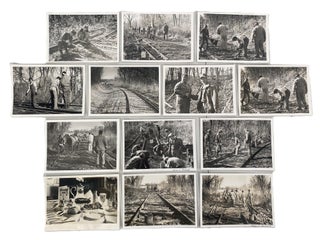
American Agricultural Chemical Company corporate promotional album, c. 1955, advertising Florida phosphate extraction and its conversion into fertilizer, elemental phosphorus, and chemical products during postwar agricultural expansion. The company presented phosphorus as essential to agricultural productivity and its mining operations as the means of supplying it. By World War I, Black workers constituted a majority of Polk County phosphate mine laborers, and A.A.C.’s own records elsewhere document racial job separation and substantial wage disparities for Black employees as late as the 1940s. The same operations removed as much as 40 feet of overburden, consumed large quantities of groundwater, and sent clay waste to settling areas two decades before Florida required reclamation of phosphate mined land. A.A.C. linked the mines directly to modern agricultural productivity, as phosphorus restored soil fertility and supported higher crop yields, while the company’s 1955 sales reached $68.7 million, nearly double its 1946 total. The album advertises agricultural abundance while providing direct evidence of the Black labor, water use, land disturbance, machinery, and capital required to produce it.American Agricultural Chemical Company, New York and Pierce, Florida, circa 1955. Promotional album with 37 silver gelatin photographs, approximately 8 x 10 inches; 38 individual typed caption sheets; 25 pages of supplemental printed material; ring bound album, 10.5 x 10 inches, approximately 1 inch thick. The Florida sequence follows phosphate from deposits 5 to 20 feet thick beneath as much as 40 feet of overburden through dragline excavation, hydraulic mining, washing and recovery, drying, grinding, storage, and rail shipment. One caption describes a 175 foot boom and 17 cubic yard bucket lifting 25 to 30 tons with each pass; another records the hydraulic gun breaking the mined matrix into slurry before it was pumped to the washing plant. Subsequent images show the South Pierce washer and recovery plant, Pierce drying and grinding works, laboratories, rail loading facilities, product handling, and workers bagging ground Florida pebble phosphate rock, followed by A.A.C. fertilizer and chemical plants at Saginaw and Detroit, Michigan; Cairo and Cleveland, Ohio; Three Rivers at Phoenix, New York; Carteret, New Jersey; and Baltimore, Maryland. The supplemental material includes A Trip Through Phosphate Center, U.S.A., describing the business as a “Story of an enterprise founded on rock,” sections titled “The Vital Role of Phosphorus” and on the geology of Florida pebble phosphate, and the company’s August 22, 1955 report to stockholders. The report records net profit of $4,399,085.93, total assets of $48,215,646.80, and stockholders’ equity of $39,596,712.05.
Florida did not require phosphate mine reclamation until July 1, 1975, and the state later identified 149,130 acres disturbed before that date for its separate nonmandatory reclamation program. USGS research found a long decline in upper Peace River flow beginning in 1931, associated with groundwater withdrawals for phosphate mining and agriculture that lowered the Upper Floridan aquifer by as much as 60 feet. Fertilizer production created another waste stream: processing phosphate ore into phosphoric acid leaves phosphogypsum containing concentrated radium, now managed in engineered stacks because of radon emissions and contaminated process water, while excess phosphorus from agricultural fields can enter waterways and promote eutrophication, hypoxia, and harmful algal blooms.
By World War I, Black workers formed a majority of Polk County phosphate mine laborers, and Black and white miners joined the 1919 strike for higher wages and an eight hour day. Pierce maintained separate white and African American public schools during the 1930s and 1940s, while A.A.C.’s Alexandria operation provides direct evidence of racial inequality within the company: in 1944, fifty nine African American employees stopped work, and the National War Labor Board found their wages substantially below comparable regional rates while white machinists worked separately from phosphate rock labor. Brown ring binder with light exterior wear; caption and supplemental sheets with light toning and occasional edge wear; photographs generally clean with scattered minor handling marks. Overall good condition. A corporate advertisement for postwar agricultural abundance preserving unusually detailed evidence of the land, water, segregated labor, machinery, and capital required to produce it.
Item #23934
Price: $725.00
See all items in African American Labor & Employment, Reconstruction & Jim Crow, Florida, Reconstruction & Jim Crow, Environment & Resources, Industrialization, Manufacturing, and Infrastructure
See all items in African American History, American History by State, Civil Rights, Labor, Environment & Industry
See all items by American Agricultural Chemical Company
See all items in Florida
Suggested Industrialization, Manufacturing, and InfrastructureBrowse All


Suggested FloridaBrowse All



Suggested African American HistoryBrowse All





Suggested American History by StateBrowse All