Pancho Villa, Pershing, and the Mexican Border Crisis, 1916
Photograph
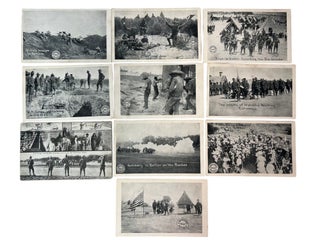
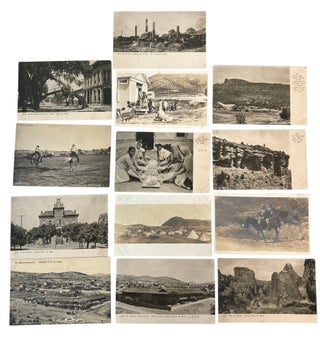
Pancho Villa’s forces photograph archive of U.S. troops, Mexican soldiers, refugees, and the militarization of the Rio Grande during the 1916 border crisis, documenting the collision of the Mexican Revolution with American militar; within a week, Brigadier General John J. Pershing led an American expedition into Chihuahua, where more than 14,000 Regular Army troops served in the campaign to pursue Vy policy and popular culture. Villa’s March 9, 1916 raid on Columbus, New Mexico carried the revolutionary war directly across the international boundaryilla. By the end of that summer approximately 110,000 National Guardsmen had been concentrated along the border from California to Texas, creating a mass mobilization immediately before the United States entered the First World War. Kavanaugh’s real photo postcards record this crisis, showing active combat, entrenchment, artillery, and refugee admission.Photo archive of 10 real photo postcards, approximately 5.5 x 3 inches, El Paso and the U.S. Mexican border region, circa 1916. Each bears the circular “Kavanaugh’s War Postals” device; the University of New Mexico catalogs Kavanaugh’s War Postals of El Paso within its Punitive Expedition into Mexico Pictorial Collection, where the publisher appears alongside other major photographic producers working the border during 1916 and 1917. One photograph shows Mexican refugees carrying their possessions beneath the caption “Refugees at the border awaiting admission to the U.S.” and armed American soldiers stationed opposite Mexico beneath “U.S. troops on the Rio Grande watching the Mexican side.” Another records the human cost of Villa’s raid under the caption “The results of watchful waiting Columbus,” showing the coffins of Americans killed at Columbus and converting the dead into a direct attack on Wilson’s Mexico policy; historians of postcard culture have specifically identified this image as an example of captions turning photographic news into contemporary political argument. San Diego History Center Military subjects cover both sides of the conflict: “Villa’s troops in action,” “Mexican raiders,” and “Mexican soldiers on the border” place armed Mexican forces at the center of the series, while “U.S. Army intrenching in Old Mexico,” “On the firing line,” and “Artillery in action on the border” record American field operations with trenches, rifles, and firing artillery. “Boys in kakhi guarding the Rio Grande” opens onto a large tented military encampment, while another camp view shows soldiers beside an American flag, pyramidal tents, and field equipment. These same Kavanaugh titles survive in other documented 1916 border postcard groups, establishing them as part of a larger visual record produced and circulated during the Villa crisis.
Villa’s attack on Columbus forced the Wilson administration from border defense into a military expedition that advanced as far as Parral, roughly 400 miles south of the border, while diplomatic relations with the government of Venustiano Carranza deteriorated toward the possibility of open war. Pershing never captured Villa, but the campaign became a major proving ground for the U.S. Army immediately before World War I, commonly identified as one of the final large scale American cavalry campaigns and one of the first to employ trucks and airplanes extensively in field operations. Army Historical Program Kavanaugh’s captions preserve the popular language surrounding that transformation. Mexican fighters become “raiders,” U.S. soldiers become “boys in kakhi,” Wilson’s “watchful waiting” is made responsible for the Columbus dead, and civilians displaced by revolution appear at the border defined by whether they will be admitted to the United States. Along with documenting Pershing’s pursuit of Villa, this archive shows the emergence of the Mexican border as a militarized political space and the commercial photographic culture through which Americans understood revolution, intervention, migration, and national defense in 1916. Light to moderate surface wear and toning with minor edge wear; one card postally used. Overall in good condition.
Item #23905
Price: $850.00
See all items in New Mexico, Borderlands, Border Wars, Mexican Revolution, Latino Community & Immigration, Borderlands, Border Wars, Mexican Revolution, Military & War Photography, Mexico, South & Central America
See all items in American History by State, Chicano & Latin American History, Military & War, Photography, World History by Geography
See all items by Pancho Villa
See all items in Mexico, New Mexico
Suggested Borderlands, Border Wars, Mexican RevolutionBrowse All




Suggested New MexicoBrowse All

Suggested World History by GeographyBrowse All



Suggested PhotographyBrowse All