U.S. Army Early Missile Range Operations at Fort Bliss and Southern New Mexico, 1957-59
Photograph
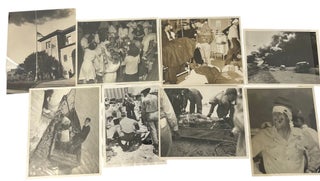
U.S. Army missile testing and range operations photo archive, 1957 to 1959, documenting the personnel, mobile equipment, fueling procedures, launch preparation, range infrastructure, and actual firings that supported guided missile operations associated with Fort Bliss and the Army's southern New Mexico ranges. Fort Bliss had become the Army's antiaircraft training center during World War II and developed into a principal center for guided missile instruction during the Cold War, with trained missile crews traveling onto New Mexico firing ranges for live exercises. Rather than concentrating exclusively on missiles in flight, the photographs record the field organization required to put them there: propellant trucks, cranes, launch structures, transport vehicles, protective clothing, range camps, and crews working around missiles marked “U.S. Army.”Archive of 12 Large silver gelatin photographs printed on eight sheets, each approximately 8 x 10 inches, Fort Bliss, Texas and associated southern New Mexico firing ranges, 1957 to 1959. Several sheets carry Firestone Tire & Rubber Co., Photographic Dept., California Division stamps, negative numbers, dates, photographer credits, and restrictions against release for publicity without prior approval. A February 18, 1957 photograph credited to Oscar G. Souza identifies an “Army propellant fueling truck” pulling into a firing area with crew standing by, while another image shows men in protective suits handling hoses beside heavy vehicles and missile support equipment. Launch preparation appears in photographs of a tall missile marked “U.S. Army” standing vertically in its launcher as soldiers work around its base, and in a multi-image sheet showing cranes, trucks, handling apparatus, and successive stages of field preparation. Two large photographs capture missiles climbing through clouds immediately after launch, their exhaust plumes recording the transition from ground operation to flight. Range views establish the physical environment surrounding these activities: rows of barracks and service buildings spread across open desert beneath mountain ranges, roads linking dispersed facilities, and a cylindrical storage structure standing above one camp. A photograph dated April 13, 1959 is captioned “General view of Oro Grande Range Camp, N.M., taken from Elephant Mountain,” directly locating part of the group within the New Mexico range system associated with Fort Bliss. Other prints retain handwritten negative numbers in their lower margins.
The photographs belong to the decade in which guided missiles altered the organization of American air defense and forced the Army to train soldiers not simply as artillerymen but as operators of increasingly technical weapons systems. Fort Bliss trained Nike missile crews that traveled north into New Mexico to complete live firing exercises, while its range network provided the acreage and controlled space necessary to operate weapons whose requirements extended far beyond a conventional artillery emplacement. Oro Grande formed part of the northern Fort Bliss range complex, with its camp supporting units conducting testing and training in the surrounding ranges. The Firestone photographic markings add the presence of a major defense contractor to this record of Army operations and show that at least part of the photographic documentation was produced within the industrial network supporting Cold War weapons programs. Light surface wear, handling marks, occasional edge creasing and minor corner wear; stamps, typed captions, negative numbers, and publication restrictions remain legible. Overall very good condition. An operational record of the personnel, machinery, infrastructure, and procedures required for U.S. Army missiles.
Item #23759
Price: $1,800.00
See all items in New Mexico, Texas, Cold War & Nuclear History, Documentary & Press Photography
See all items in American History by State, Military & War, Photography
See all items by U S. Army Missile Testing
See all items in Texas, New Mexico
Suggested New MexicoBrowse All




Suggested TexasBrowse All




Suggested PhotographyBrowse All

Suggested American History by StateBrowse All