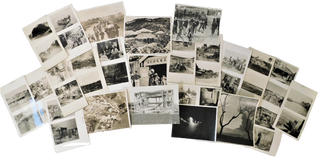
Japanese Occupation of Hangzhou China and the Military Administration of Zhejiang Photo Archive, 1939
Photograph
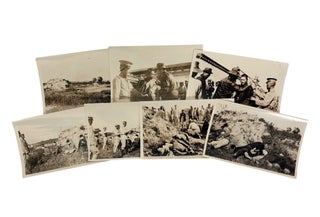
Japanese occupation of China photo archive depicting military administration and daily life in Hangzhou, 1939, documenting how the Imperial Japanese Army imposed control over one of China's most important cultural capitals during the early years of the Second Sino Japanese War. Captured by Japanese forces in December 1937 after the collapse of Chinese defenses following the Battle of Shanghai and the fall of Nanjing, Hangzhou remained under occupation until 1945, becoming part of Japan's expanding system of military rule across eastern China. These photographs record both the machinery of occupation and the altered rhythms of civilian life, showing soldiers, prisoners, bomb damage, public spaces, transportation, and ordinary residents living within a city under foreign military control.Photo archive of 25 silver gelatin photographs, each measuring 1.75 x 2.25 inches, Hangzhou, China, 1939. The photographs show Japanese soldiers drilling, posing in uniform, and participating in military ceremonies; guards standing beside railway rolling stock and station platforms; troops demonstrating rifle marksmanship; prisoners or detainees under military supervision; and Japanese personnel engaged in what appears to be ceremonial or recreational activities. Civilian life appears throughout the group in photographs of Chinese women, children, fishermen, street scenes, market districts, temple architecture, lakeside promenades, pavilions around West Lake, and interior commercial displays bearing Chinese signage. Several images record extensive wartime destruction, including collapsed neighborhoods, burned waterfront districts, ruined masonry buildings, smoking urban landscapes, and cleared industrial sites. The archive juxtaposes military occupation with recognizable landmarks of Hangzhou, producing a visual record of a city simultaneously functioning as an occupied administrative center and enduring the physical consequences of invasion.
The Japanese Army occupied Hangzhou on 24 December 1937 as it advanced through Zhejiang following the capture of Shanghai and Nanjing, incorporating the city into a broader occupation regime that relied upon military garrisons, transportation networks, local policing, and collaborationist administration to secure eastern China. During 1939 the occupation entered a more settled phase in which combat receded inside the city while military infrastructure, rail transport, public order, and civilian adaptation became defining features of everyday life. The combination of military personnel, damaged urban landscapes, traditional cultural sites, transportation facilities, and civilian activity distinguishes this archive from purely battlefield photography by documenting the coexistence of violence, governance, and ordinary existence within an occupied Chinese city. Light surface wear and occasional silvering at the edges; overall in very good condition. A concentrated visual record of Japanese military occupation and civilian life in Hangzhou during the formative years of the occupation of eastern China.
Item #23593
Price: $550.00
See all items in Imperialism & Colonialism, Military & War Photography, China, Japan
See all items in Military & War, Photography, World History by Geography
See all items by Occupation of Hangzhou China
See all items in China
Suggested JapanBrowse All



Suggested ChinaBrowse All




Suggested PhotographyBrowse All

Suggested World History by GeographyBrowse All