Largo, Florida on the Edge of a New Suburban Culture: George Fulmer Photograph Archive Documenting High School Life, Future Farmers and Homemakers, Youth Culture, Agriculture, Housing, Commerce, and the Postwar Transformation of a Citrus Economy, c. 1951
Photograph
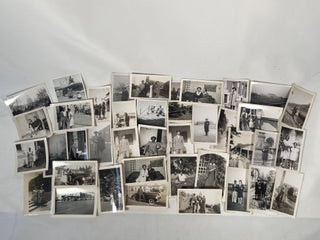
Largo, Florida photograph archive taken by George Fulmer, c. 1951, documenting education, youth culture, housing, commerce, religion, and recreation as a citrus and farming community entered the first phase of its postwar transformation into a suburban city. Largo’s population and physical landscape changed rapidly after World War II as groves and grazing land gave way to housing and industrial development; within the wider Pinellas County school system, enrollment rose from roughly 16,000 students in 1946 to about 69,000 in 1962, requiring the construction of 64 new schools between 1948 and 1965. The photographs concentrate unusually closely on the generation educated during this transition, recording Largo High School athletics, Future Farmers of America, Future Homemakers of America, youth baseball, school music, and other organized activities at the moment when the occupational and domestic assumptions of an agricultural community were meeting the demographic and economic conditions of suburban Florida.Photo archive of approximately 87 items including 38 silver gelatin photographs, and approximately 38 corresponding large format negatives, photograph prints ranging from 4.5 x 2.5 to 5 x 4 inches, and each negative about 4 x 5 inches, all retained in 11 original numbered photographic job envelopes bearing client, subject, and occasional date notations, Largo, Florida, principally 1951. The photographs and negatives were made by George Fulmer, the longtime Clearwater commercial and civic photographer whose surviving files document decades of local institutional life in central Pinellas County. The original job envelopes preserve Fulmer’s assignment structure, linking negatives and prints to named Largo clients and subjects rather than leaving the photographs as unidentified local views. The school material includes a large Largo High School Future Homemakers of America group posed beneath the organization’s emblem; young women displaying and examining patterned skirts and clothing outdoors; a group identified on its envelope as “Largo High School Boys Girls FFA & FHA”; and children and adolescents posed beneath a sign reading “Largo Chapter Future Farmers of America Department of Vocational Agriculture,” some holding hoes, shovels, and other agricultural implements. Football assignments show night games under field lights, players running, tackling, and breaking through defensive lines, referees moving through plays, crowded grandstands, cheerleaders, and a large uniformed marching band packed into the bleachers. Other files document Largo Junior League baseball teams posed with bats, gloves, coaches, and locally lettered uniforms; a Largo Baptist Church choir arranged in the sanctuary; Sinclair gasoline station employees receiving a trophy beside an HC gasoline pump; new residential and commercial buildings; and modern domestic interiors furnished with low upholstered seating, lamps, paneled walls, and contemporary cabinetry. Most negatives duplicate surviving prints.
The Largo recorded here was still closely identified with agriculture. Citrus, cattle, and dairy had dominated the local economy through much of the early twentieth century, and Largo had developed into one of Florida’s major citrus centers after the arrival of the railroad; within a few years of these photographs, freezes in 1957 and 1962 damaged the citrus economy while population growth increased demand for residential and commercial land. Largo High School embodied that transition directly. Its own history recalls an educational culture in which young men studied agriculture, tractor repair, wood shop, and animal science while young women took home economics, a gendered vocational division visible here in the paired presence of Future Farmers and Future Homemakers. The Future Homemakers photographs record an educational ideal that treated domestic labor, clothing, food preparation, and household management as formal preparation for female adulthood, while the FFA material trained boys for an agricultural economy whose physical basis was already beginning to contract. Largo’s accelerating growth soon made the older educational infrastructure inadequate: in 1957 a new Largo High School opened taking 37 acres of land. Postwar industrialization accelerated this transformation as Honeywell and General Electric facilities helped move Largo from an agricultural center toward a suburban economy; housing and trailer parks replaced groves and grazing land, and by 1970 the city counted roughly 22,300 residents, up from 5,302 in 1960. The apparently all white school organizations also belong to Pinellas County’s segregated educational structure: after the 1954 Brown v. Board of Education decision, the county nevertheless built nine additional all Black schools between 1954 and 1963, and only about 200 Black students attended desegregated county schools in 1964. The photographs show some curling but remain in very good condition. Some negatives show fading; original paper job envelopes show handling wear. Overall in very good condition.
Item #23792
Price: $780.00
See all items in Florida, Urbanization & City Development, Documentary & Press Photography, Vernacular & Community Photography, Women’s Education
See all items in American History by State, Labor, Environment & Industry, Photography, Women’s History & Feminism
See all items by George Fulmer Florida Sunbelt Expansion
See all items in Florida
Suggested Women’s EducationBrowse All






Suggested FloridaBrowse All




Suggested PhotographyBrowse All


Suggested American History by StateBrowse All