Florida’s Mid-Century Modern Ranch Houses and the Architecture of the Postwar Sunbelt: 104 Photographs and Negatives from Pinellas County, circa 1951
Photograph
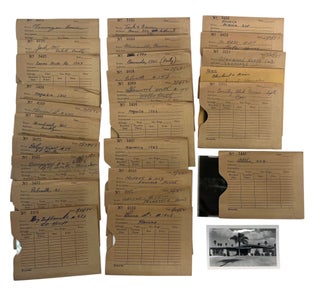
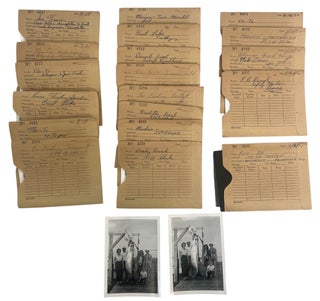
Pinellas County residential real estate photo archive, c. 1951, documenting the physical form of Florida’s early postwar housing expansion as new construction spread across the Tampa Bay peninsula. Rather than concentrating on realtors and the commercial machinery of development, this group records what that expansion produced at street level: detached houses, small apartment buildings, broad lawns, attached garages and carports, screened living areas, palms planted in newly graded yards, and modern houses rising on lots where the surrounding landscape remained thinly developed. The photographs belong to the opening years of the enormous demographic shift that remade Florida after World War II, when federally supported mortgage finance, automobile ownership, road construction, inexpensive peripheral land, air conditioning, retirement migration, and the movement of veterans and young families southward converted places such as Pinellas County into rapidly expanding residential markets.Photo archive of approximately 104 items, comprising 50 silver gelatin photographs and 54 corresponding large format negatives, contained in envelopes with captions and some dates, Pinellas County, Florida, c. 1951. Most approximately 4 x 5 inches. Photographed by George Fulmer, the images record individual residences and small multifamily properties identified on their envelopes by street, development, owner, or client, including Indian Rocks Road, Magnolia, Palmetto, Mohawk, and many others. The houses range from modest one story dwellings with simple carports and newly seeded or sparsely planted lots to larger ranch houses with double garages, screened porches, picture windows, masonry construction, tile roofs, broad rooflines, and carefully landscaped approaches. Several photographs are especially revealing of the unfinished character of new development: recently built houses stand against sandy yards and scattered pines, concrete drives terminate at lightly developed streets, and young ornamental plantings have only begun to replace the native landscape. Other properties show the opposite end of the process, with established lawns, mature palms, curving drives, elaborate screened rooms, and increasingly substantial automobile accommodation. Small apartment buildings extend the record beyond the detached house, showing how Pinellas County’s population growth also generated denser forms of residential construction. The negative envelopes retain contemporary property identifications and job numbers, with numerous examples carrying dates in 1951, preserving the working information that connects Fulmer’s architectural views to individual addresses and real estate assignments.
The housing recorded here emerged from a national postwar system that dramatically expanded the number of Americans able to purchase new homes. Federal Housing Administration mortgage insurance had already encouraged long term, low down payment lending and standardized construction before the war; the Servicemen’s Readjustment Act of 1944 added federally guaranteed Veterans Administration mortgages for millions of returning servicemen. These programs reduced the capital required for homeownership and gave builders a dependable financing structure for large volumes of new housing, while federal highway spending and local road construction made inexpensive land beyond older urban centers practical for automobile dependent development. Those benefits were distributed unequally. FHA underwriting practices and racially restrictive real estate customs helped channel federally supported credit toward predominantly white suburban development while limiting Black access to many of the same mortgages and neighborhoods, making the postwar housing boom simultaneously a history of expanded homeownership and of the racial geography built into twentieth century metropolitan growth. Pinellas County became one of Florida’s clearest expressions of the larger Sunbelt transformation: houses, roads, lawns, garages, apartment courts, and subdivisions replaced undeveloped acreage as migration and real estate construction reorganized the peninsula around residential property and automobile travel. Light handling wear and occasional surface marks consistent with working photographic material; envelopes with expected toning and handling wear. A few negatives extremely warped showing deterioration, but the vast majority very good.
Item #23854
Price: $700.00
See all items in Urbanization & City Development, Florida, Urbanization & City Development, Vernacular & Community Photography
See all items in American History & Americana, American History by State, Labor, Environment & Industry, Photography
See all items in Florida
Suggested FloridaBrowse All




Suggested PhotographyBrowse All






Suggested American History by StateBrowse All