African American Military History Korean War Aftermath: Black U.S. Army Engineers in South Korea, 1956 Post Armistice Occupation
Archive
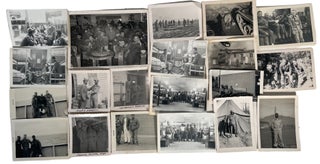
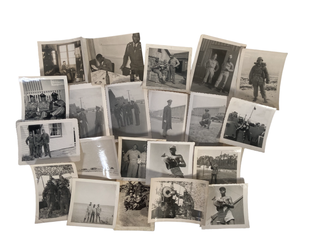
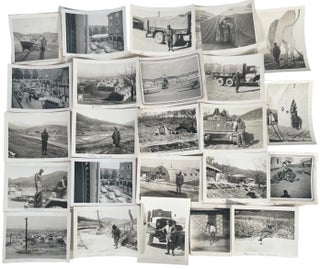
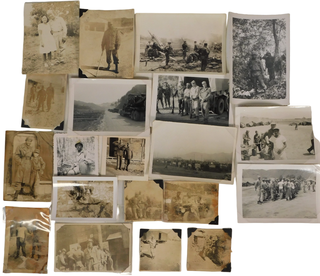
[African American] [Military History] [Korean War] Unidentified photographer, African American soldiers in South Korea, 1956 documents Black military service within the early post armistice U.S. occupation of Korea and provides visual evidence of desegregation in practice following Executive Order 9981. Produced three years after the Korean Armistice Agreement, the images situate African American enlisted men within the operational landscape of U.S. military engineering and logistical support during the Cold War consolidation of American presence on the Korean peninsula. The archive documents the role of Black soldiers in infrastructure maintenance, transport, and base security while also recording their proximity to Korean civilian life in a recovering war zone. The identification of the 376 Engineer Battalion places the material within the institutional framework of the U.S. Army Corps of Engineers, whose work underpinned military mobility and reconstruction during this period.South Korea, 1956. Archive of 22 black and white silver gelatin photographs, most measuring approximately 5 x 4 inches, depicting African American soldiers stationed near a U.S. military installation, likely in the Uijeongbu or Dongducheon corridor north of Seoul where engineering and support units were concentrated. Multiple images include signage identifying the “376 Engineer Battalion,” while others show mixed-race groups of soldiers gathered near convoys of M35 2½ ton cargo trucks and smaller support vehicles used for personnel and supply transport. One photograph includes a Fairchild C-119 Flying Boxcar aircraft in the background, confirming the logistical environment of cargo movement and aerial supply. Soldiers appear in standard issue fatigues with visible non commissioned officer insignia, engaged in routine duties such as transport, checkpoint supervision, and base operations. Several photographs depict Korean civilians moving through nearby marketplaces and village spaces, including women wearing traditional hanbok passing through areas of visible economic strain characterized by unpaved roads and temporary structures. English and Hangul signage, including a storefront labeled “Kind Shop,” further situates the images within a localized commercial environment shaped by U.S. military presence.
The archive documents a transitional period in both U.S. military policy and Korean society, as the formal desegregation of the armed forces intersected with the realities of overseas deployment in a recently devastated region. While integrated units are visible, the clustering of Black soldiers within shared duties and informal groupings indicates the persistence of racialized social structures within the ranks. At the same time, the photographs establish the everyday presence of American troops within civilian Korean spaces during early Cold War reconstruction, linking military labor to broader geopolitical objectives in East Asia. Light surface wear including minor creasing and scattered abrasions; images remain clear with strong contrast. Overall very good condition. A cohesive visual record of African American military labor, postwar occupation, and cross cultural contact in Korea during a formative phase of U.S. global military expansion.
Item #21513
Price: $885.00
See all items in African American Military Service, Korea, Korean War
See all items in African American History, International & Global Culture, Military & War, Photography, Archive
See all items by African American Servicemen Korea
See all items in Korea
Suggested African American Military ServiceBrowse All



Suggested Korean WarBrowse All




Suggested KoreaBrowse All
Suggested African American HistoryBrowse All