Shilluk Indigenous African Peoples of the Nile and Congo in Colonial Era Field Encounters, 19 Photos, 1920s-30s
Photograph
Indigenous peoples of Africa photo archive, circa 1920s-1930s, recording Shilluk, Sudanese, Congolese, Nile, and Victoria Falls subjects within the colonial-era climate of expeditionary travel and anthropology. The captions identify locations and peoples across a wide geographic range, including “Shilluks of the Nile, Sudan, Africa,” “Pygmies Congo,” “Natives White Nile,” and “Victoria Falls Africa.” Such material was produced during a period when European and American travelers, researchers, missionaries, and press photographers circulated native African culture for audiences shaped by imperial geography, ethnographic classification, and popular fascination with the African continent.Photo archive of 19 silver gelatin photographs, each 3.25" x 5.25", Africa, circa 1920s-1930s. Subjects include Shilluk men posed with bead necklaces, arm ornaments, headbands, and draped cloth; Sudanese girls seated outdoors; men gathered beside dugout canoes on the Nile; a riverside settlement captioned “On the Banks of the Nile”; and a line of men identified as “Stork Men.” The Congo section includes a group gathered in a forest clearing and a Western man standing beside Congolese natives under the caption “Pygmies Congo.” Additional portraits emphasize hair styling, scarification, beadwork, body ornament, and dress, including captions reading “Fancy Hair Styles Africa,” “Beauties of Africa,” “Native of Nile,” and “Sudanese White Nile.” Victoria Falls appears in two views, placing human subjects within a broader travel record of African geography and spectacle. Captions on many of the margins
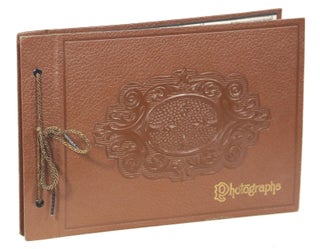
By the early twentieth century, much of Africa had been divided among European colonial powers following the 1884-1885 Berlin Conference, which formalized imperial claims across the continent without African participation. The archive records how African people and places were subjects of anthropological research and interest to Westerners. The captions preserve period terminology, named regions, and the collecting habits of a Western observer moving across Sudan, Congo, the Nile, and Victoria Falls. The presence of the Western man posed with Congolese subjects is especially important, marking the encounter as more than scenic tourism and aligning the group with field travel, research, missionary contact, or journalistic documentation. Mounted on black album leaves with handwritten captions; some prints show fading, edge wear, and light surface abrasion, and the mounts show chipping and losses at corners. Overall in very good condition. Portraits emphasizing scarification, ornament, hairstyles, and bodily presentation were often produced within a colonial framework that treated African communities as subjects of scientific, racial, or geographic classification. At the same time, these scenes now preserve important visual records of cultural practices, regional identity, and daily life during a period of rapid political and social transformation under colonial rule.
Item #23432
Price: $550.00
See all items in World Indigenous Peoples, Africa, Imperialism & Colonialism
See all items in Indigenous Peoples, International & Global Culture, Archive
See all items by Indigenous African Peoples Colonial Africa
See all items in Africa
Suggested World Indigenous PeoplesBrowse All


Suggested Imperialism & ColonialismBrowse All


Suggested AfricaBrowse All



Suggested Indigenous PeoplesBrowse All