Texas City Disaster Photography of Fire, Rescue, and Recovery, Photo Archive, April 1947
Photograph
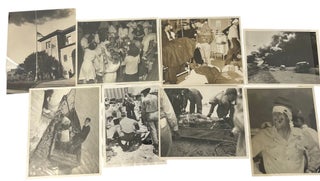
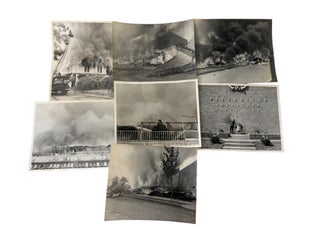
Texas City disaster press photographs recording emergency treatment, industrial fire, body recovery, and civic mourning in Texas City, Texas, in the immediate aftermath of the April 16, 1947 port explosions. The SS Grandcamp, loaded with 2,300 tons of ammonium nitrate fertilizer manufactured from surplus WWII munitions material and bound for war-torn Europe, detonated at the Texas City port on April 16, 1947. The blast ignited the surrounding oil refineries and petrochemical tank fields, killing at least 581 people. The following day, the SS High Flyer, carrying additional ammonium nitrate and sulfur, exploded in the same harbor, and remains one of the deadliest industrial accidents in American history. The sequence covers the functions that followed the explosion: improvised plasma treatment among debris, volunteer women sorting and distributing medical supplies, recovery crews lifting an oil-covered body from the water, and public signs of mourning.Photo archive of 8 Large Vintage silver gelatin photographs, two photographs retain Acme Newspictures press captions identifying Texas City and dating transmission to April 18, 1947. The images include a road crowded with abandoned automobiles as dense black smoke rises from burning tank fields; an exterior view of a civic building with the American flag at half staff beneath a heavy cloud bank; a crowded interior in which women in white uniforms and other volunteers work around tables loaded with bottles, cartons, and medical supplies; and a casualty ward scene in which Salvation Army men and other responders stand over an injured man on a cot while additional victims lie on the floor under blankets. Two photographs focus on a dead man coated in oil, first in the water beside a small workboat and then on a stretcher as three workers bend over the body. A close portrait shows an injured man with a head bandage and facial burns or dressings. Verso evidence includes typed Acme captions. One reads in part, "Millions in Property Damage in Texas Blasts," describing black smoke from "blazing tanks" and roads littered with debris; another, captioned "Disaster Victim Gets Plasma," states that there was no time to move victims to the hospital and identifies on-site medical treatment in the wrecked city. Additional versos carry agency stamps, editorial markings, and one handwritten notation reading "Flag at half."
The Texas City disaster exposed the concentration of explosive cargo, petroleum storage, dock labor, and wartime-expanded Gulf Coast industry within a single port. The photographs show the human systems activated after the blast: emergency medicine, religious relief presence, volunteer supply distribution, corpse recovery, and press circulation. The archive moves from explosion to treatment to recovery, documenting both the fire and the response. Light curling overall, scattered verso markings, minor handling wear; overall good condition. The Texas City disaster remains the deadliest industrial accident in American history and reshaped federal regulation of hazardous cargo, port safety, and ammonium nitrate handling for the rest of the twentieth century.
Item #23261
Price: $750.00
See all items in Industrialization, Manufacturing, and Infrastructure, Natural & Industrial Disasters, Texas, Industrialization, Manufacturing, and Infrastructure, Documentary & Press Photography
See all items in American History & Americana, American History by State, Labor, Environment & Industry, Photography
See all items by Texas City Disaster
See all items in Texas
Suggested Industrialization, Manufacturing, and InfrastructureBrowse All


Suggested TexasBrowse All




Suggested PhotographyBrowse All



Suggested American History by StateBrowse All