African American Education History Lewis B Moore Howard University Correspondence on Teacher Placement and War Era Service 1916 to 1923
Archive
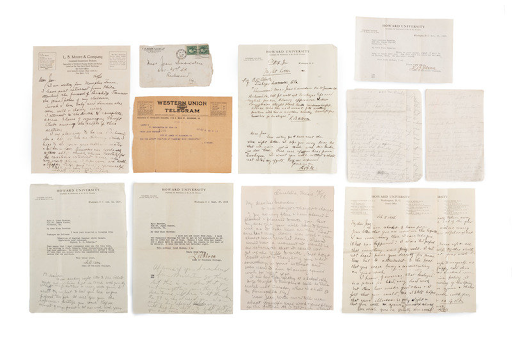
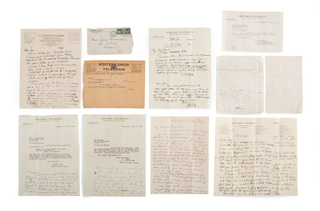
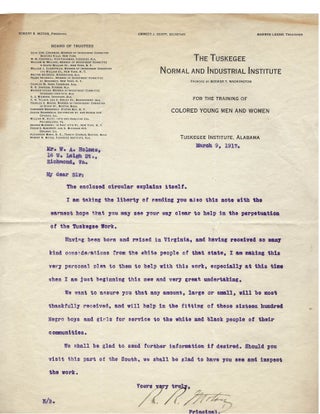
Moore, Lewis B. correspondence, 1916 to 1923, documents the role of a leading African American educator in shaping professional pathways for Black teachers within segregated educational systems and wartime conditions. Lewis Baxter Moore, founding dean of the Teachers’ College at Howard University and among the earliest African Americans to earn a PhD in the United States, appears here in direct correspondence advocating for his former student Anna Jean Snowden’s placement at Tuskegee Institute. The letters situate Moore within a network of Black educational institutions that functioned as primary sites of professional advancement during Jim Crow, while also recording the impact of World War I on academic life, as male students were “gradually taken away for service in War” and faculty participated in organized wartime efforts.Archive of 9 documents. United States, 1916 to 1923. Group includes autograph letters signed and typed letters signed by Lewis B. Moore (“L.B. Moore” and “L.B.M.”), as well as a telegram. Correspondence primarily concerns Moore’s efforts to secure a teaching appointment for Anna Jean Snowden at Tuskegee Institute. In a letter dated 12 October 1917, Moore writes that he has recommended Snowden for a “Position of English Teacher,” adding, “I shall try my best to land you here as you preferred this job. It will give you the experience and prestige you want…You will like the place I am sure.” Letters from 1918 reference wartime disruption, including Moore’s statement that students were being removed for military service and his remark, “This awful conflict is stunning!!,” alongside a later note that he had “been on the road since May doing war work.” Additional materials include a letter from G.W. Goode, Warrenton, Virginia, 1 September 1917, requesting assistance in locating a qualified graduate for a teaching post, and an undated 8-page personal letter addressed to Snowden from her sister Lillian Snowden, discussing family, employment, and social matters, with reference to “Mrs. Walker.”
The archive documents the function of historically Black institutions such as Howard University and Tuskegee Institute as interconnected sites of training, placement, and advancement for African American educators in the early twentieth century. Moore’s intervention on behalf of Snowden provides direct evidence of faculty-led patronage systems that helped graduates secure positions within a limited but expanding network of Black schools. His wartime remarks align with his broader published work supporting Black participation in World War I and addressing conditions in military communities, linking educational leadership to national service discourse. Snowden’s subsequent appointment at Tuskegee confirms the practical outcome of these efforts, illustrating how individual correspondence facilitated institutional mobility within segregated professional structures. Light wear consistent with handling; overall very good condition.
Item #18581
Price: $880.00
See all items in African American Education, Alabama
See all items in African American History, American History by State, Archive
See all items by HBCU Howard University
See all items in Washington D.C, Alabama
Suggested African American EducationBrowse All




Suggested AlabamaBrowse All

Suggested African American HistoryBrowse All








Suggested ArchiveBrowse All