African American Education During Jim Crow: Howard University Dean Lewis B. Moore Correspondence Archive Securing a Black Woman Educator’s Appointment at Tuskegee Institute, with World War I Content, 1916–1923
Archive
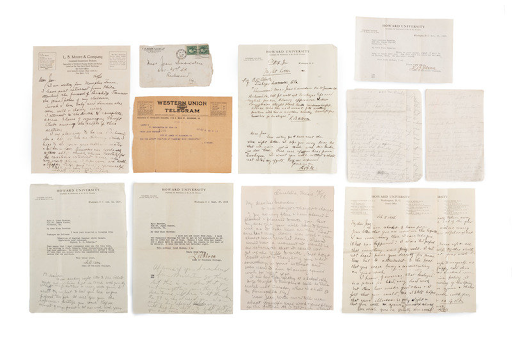
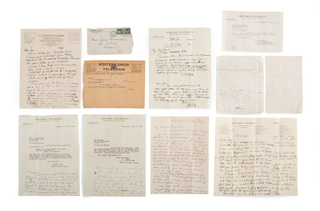
ewis B. Moore correspondence, 1916–1923, documenting the role of one of the nation’s pioneering African American scholars and educators in creating professional opportunities for Black teachers during the Jim Crow era. Moore, founding dean of the Teachers’ College at Howard University and the first person of African descent to earn a PhD from the University of Pennsylvania, appears here in direct correspondence advocating for his former student Anna Jean Snowden and helping secure her appointment at Tuskegee Institute. The archive provides a revealing record of the networks connecting historically Black educational institutions and the personal intervention often required for African American graduates, particularly women, to obtain professional positions within a segregated educational system. The correspondence also records the disruption of Black academic life during World War I and Moore’s own participation in wartime work.Archive of 9 letters and documents, 1916–1923, including autograph letters signed and typed letters signed by Lewis B. Moore (“L.B. Moore” and “L.B.M.”), as well as a telegram. The correspondence predominantly concerns Moore’s efforts on behalf of Anna Jean Snowden, a former Howard student seeking a teaching position. In a letter dated October 12, 1917, Moore tells Snowden that he has recommended her for the “Position of English Teacher” at Tuskegee Institute and assures her, “I shall try my best to land you here as you preferred this job. It will give you the experience and prestige you want…You will like the place I am sure.” Snowden subsequently received and accepted the appointment, teaching at Tuskegee from at least 1917 to 1918.
The correspondence illustrates how faculty members at leading Black institutions could function not simply as educators but as intermediaries within a broader professional network. A September 1, 1917 letter to Moore from G.W. Goode of Warrenton, Virginia, who served at one time as president of the Colored Baptist Association of Virginia, asks Moore to recommend “a young lady, graduating from your teachers College who would like a position in a boarding school.” Together with Moore’s efforts for Snowden, the letter provides direct evidence of Howard Teachers’ College serving as a source of trained African American educators for Black schools elsewhere in the country. Such correspondence reveals the informal placement and patronage networks through which Black educational institutions created avenues of professional mobility at a time when opportunities within the wider American educational establishment remained sharply restricted by race and gender.
Two letters from 1918 additionally document the effects of World War I on Moore and his students. Writing to Snowden in February, Moore observes that his male students were “gradually taken away for service in War” and exclaims, “This awful conflict is stunning!!” Ten months later, explaining a delay in correspondence, he reports that he had “been on the road since May doing war work.” These remarks connect the personal correspondence to Moore’s broader public engagement with African American participation in the war. During this period he authored How the Colored Race Can Help in the Problems Issuing from the War and Report Concerning the Needs and Problems of Negroes in War Camp Communities, addressing both Black participation in the national war effort and the particular circumstances confronting African Americans in military communities.
Also included is an undated eight-page personal letter to Snowden from her sister Lillian Snowden discussing family, employment, and social matters. The letter refers to a “Mrs. Walker,” possibly Maggie L. Walker, the pioneering African American businesswoman and leader of the Independent Order of St. Luke, an organization with which Lillian Snowden was later employed. The identification cannot be confirmed from the letter alone, but the reference is noteworthy given Snowden’s subsequent association with the organization.
Lewis Baxter Moore (1866–1928) was an African American educator, scholar, minister, and administrator whose career placed him among the pioneering generation of Black academics in the United States. Born in Huntsville, Alabama, he earned his B.A. and M.A. from Fisk University before receiving his Doctor of Philosophy from the University of Pennsylvania in 1896, becoming the first person of African descent to earn a PhD from Penn. At the time, only four other African Americans had earned doctorates from American universities. Moore subsequently taught at Howard University and in 1899 founded its Teachers’ College, serving as dean until 1920. Near the end of his career he was ordained as a Presbyterian minister and spent his final years as pastor of Faith Presbyterian Church in Philadelphia.
Anna Jean Snowden (ca. 1895–1996) graduated from Howard University in 1916 with a B.S. and a teacher’s diploma in education. Moore’s correspondence documents the transition from her university training into professional employment: through his recommendation she received an offer to teach English at Tuskegee Institute, where she worked during at least 1917–1918. Her experience provides a particularly concrete example of the pathways through which educated Black women entered professional life during the early twentieth century.
Taken together, the archive documents an interconnected African American educational network linking Howard University, Tuskegee Institute, and other Black schools during the Jim Crow era. More than simply a group of letters concerning a teaching appointment, the correspondence demonstrates how a leading Black educator used his institutional position and personal relationships to create professional opportunities for the next generation of African American teachers. Moore’s wartime observations further place these educational networks within the upheaval of World War I, when Black institutions simultaneously confronted the loss of students to military service and participated in broader debates over African American citizenship and national service. Light wear consistent with age and handling; overall very good condition.
Item #18581
Price: $880.00
See all items in African American Education, African American Family & Community Life, Reconstruction & Jim Crow, Alabama, Reconstruction & Jim Crow
See all items in African American History, American History by State, Civil Rights, Autographs, Manuscripts & Letters
See all items by HBCU Howard University
See all items in Washington D.C, Alabama
Suggested African American EducationBrowse All




Suggested AlabamaBrowse All


Suggested African American HistoryBrowse All




Suggested American History by StateBrowse All