Uncorrected Proof of A Hard Road to Glory, Legendary Black Tennis Star Arthur Ashe's Comprehensive History of African American Athletes
Book
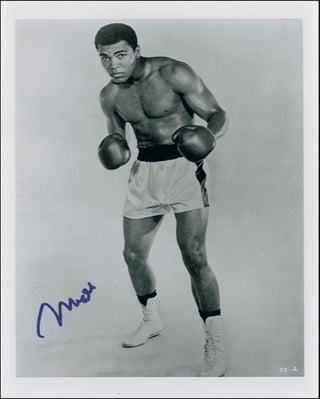
Arthur R. Ashe, Jr. A Hard Road to Glory: A History of the African-American Athlete Since 1946. New York: Warner Books, 1988. Uncorrected Proof. A rare uncorrected proof of A Hard Road to Glory, Arthur Ashe’s definitive history of African American athletes, chronicling their struggles and triumphs in the post-World War II era. Ashe, a tennis champion and civil rights advocate, sought to correct the historical neglect of Black athletes, meticulously documenting their achievements across multiple sports while contextualizing their fight for inclusion in a segregated and discriminatory society. These proofs, dated August 29, 1988, include a publisher’s letter from Charles Harris of Amistad Press, stating that “Because of an extremely tight production schedule and size of the three volumes, we are unable to provide you with the complete text.” This pre-publication copy offers a unique glimpse into Ashe’s exhaustive research and editorial process.Ashe highlights figures like Muhammad Ali, Wilma Rudolph, and Jackie Robinson, showing how their individual successes paved the way for future generations. His meticulous documentation and narrative style make this book a cornerstone in sports history, reinforcing his assertion that “America’s best black tennis players waited with the same sense of urgency after World War II as did the Negro League baseball players.” Women’s sports are prominently featured, with Ashe detailing the barriers Black female athletes faced before Title IX of the Education Amendments Act of 1972 mandated equal funding for women’s collegiate athletics. He quotes Cheryl Miller, a USC basketball star, who told Sports Illustrated, “Without Title IX I wouldn’t be here.” Ashe acknowledges Black women’s historical dominance in track and field while noting the challenges of gaining recognition in team sports. He highlights South Carolina State’s Willie Simon, who coached the team to an AIAW II title in 1979, and Virginia Union’s Louis Hearn, whose team won the NCAA II title in 1983. He also devotes attention to Vivian Stringer, the trailblazing coach who led Cheney State to the first NCAA Women’s Championship final in 1982 and later became a transformative figure in women’s basketball.
Ashe also revisits tennis, his own sport, noting the racial barriers Black players faced. He recounts the struggle of Oscar Johnson, who in 1948 attempted to integrate USTA-affiliated tournaments but was turned away despite being accepted. When Johnson arrived at the venue carrying his own rackets, the director asked, “What are you doing here, boy?” to which Johnson replied, “I’m here to play in the tournament, my application was accepted. My name is Oscar Johnson.” Ashe also highlights the pivotal role of historically Black colleges and universities (HBCUs) in fostering Black athletic talent, particularly in basketball, stating that “The black colleges were primary beneficiaries of a continuing interest in basketball immediately following World War II. Athletically gifted black GIs returned home and headed for college, where tuition was paid for with G.I. Bill benefits.” He credits dominant programs like North Carolina Central University (coached by Johnny B. McLendon), Virginia Union (Tom Harris), and Winston-Salem (Clarence “Big House” Gaines) for shaping the careers of legendary Black players. He also discusses the emergence of the Mid-Eastern Athletic Conference (MEAC) in the 1970s, which joined established Black athletic conferences such as the Central Intercollegiate Athletic Association (CIAA), the Southern Intercollegiate Athletic Conference (SIAC), and the Southwestern Athletic Conference (SWAC). This uncorrected proof is in very good condition, with clean pages and a crisp cover. A significant pre-publication artifact from Ashe’s groundbreaking work, offering a scholarly yet deeply personal examination of race, sports, and perseverance in America.
Item #21499
Price: $225.00
See all items in African American Sports, Sports, Cooking & Hobbies
See all items in African American History, Mass Media & Popular Culture, Social Activism & Protest
See all items by Arthur Ashe
Suggested African American SportsBrowse All




Suggested African American HistoryBrowse All