Iranian History and Early Photography: Three Glass Lantern Slides of Qajar Tehran, Royal Palace Gardens, and Isfahan's Khaju Bridge, circa 1905
Photograph
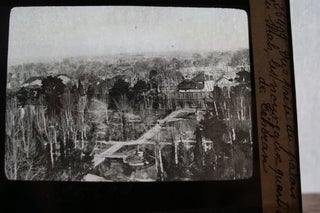
Collection of three original photographic glass lantern slides depicting the Qajar royal palace gardens in Tehran, an elevated view of the capital's developing neighborhoods, and the seventeenth-century Khaju Bridge in Isfahan, circa 1905. The Tehran images date from the reign of Mozaffar al-Din Shah Qajar (1896–1907), shortly before the Persian Constitutional Revolution and the establishment of a national parliament in 1906. One records a man in traditional Persian clothing walking through the royal palace gardens, while another, titled "The Shah's Gardens and the New Neighborhoods," presents an elevated view across Tehran's urban landscape. The third slide depicts the Khaju Bridge, commissioned by Shah Abbas II around 1650, recording one of the principal surviving monuments of Safavid architecture in Isfahan. The three views preserve early twentieth-century photographic records of Persian royal grounds, urban development, and historic infrastructure, circulated through European and American lantern-slide publishers.Three original gelatin silver bromide positive glass lantern slides, each measuring approximately 3¼" x 4", dating to circa 1905. The first depicts a Persian man wearing traditional nineteenth-century clothing and walking through the Qajar royal palace gardens in Tehran. The second presents an elevated perspective over the palace gardens and surrounding city, captioned "The Shah's Gardens and the New Neighborhoods," showing the relationship between the royal precinct and Tehran's expanding residential districts. The first two images are associated with Arthur Radiguet and the Parisian optical firm Maison Molteni, subsequently operating as Molteni, Radiguet & Massiot. The third slide, produced by the New York optical firm T. H. McAllister, depicts the Khaju Bridge spanning the Zayandeh River in Isfahan. Constructed under Shah Abbas II around 1650 on the site of an earlier crossing, the bridge incorporates 23 arches and served as a roadway, dam, and public gathering place, connecting the Khaju quarter with the opposite bank near the historic Zoroastrian district. Its arcaded construction, central pavilion, and water-regulating features distinguish it among the architectural projects of Safavid Isfahan.
The two Tehran views were distributed through the French optical industry associated with Arthur Radiguet, who died in 1905, and the Maison Molteni, a manufacturer of photographic projection apparatus and lantern slides. The Khaju Bridge image was produced by T. H. McAllister, a New York firm specializing in optical instruments and photographic lantern-slide production. Such glass transparencies were used in illustrated lectures, geographical instruction, and public presentations, projecting photographic images onto screens through optical lanterns. The elevated Tehran view records the city's development before the extensive urban alterations of the Pahlavi period, while the palace garden scene preserves details of Qajar-era royal grounds and contemporary dress. The Isfahan image records a Safavid bridge that continued to serve the city more than two centuries after its construction. All three original glass positives are in very good condition.
Item #14529
Price: $280.00
See all items in Early Photography, Travel & Cultural Photography, Iran, Middle East
See all items in Photography, World History by Geography
See all items by Qajar King Palace Iran
See all items in Iran
Suggested Middle EastBrowse All



Suggested Early PhotographyBrowse All



Suggested IranBrowse All


Suggested PhotographyBrowse All