Larry Niven’s “Neutron Star” First Publication and Early Known Space Sequence in Frederik Pohl’s Hugo-Winning Worlds of IF, with Gardner Dozois’s First Published Story, 1966
Periodical
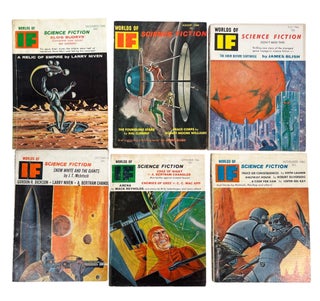
Six consecutive issues of Frederik Pohl’s Hugo Award-winning Worlds of IF Science Fiction, containing the first publication of Larry Niven’s “Neutron Star,” winner of the 1967 Hugo Award for Best Short Story, followed in the next two issues by the first publications of “At the Core” and “A Relic of the Empire.” The three consecutive appearances form an important early sequence in Niven’s developing Known Space universe and the emergence of the Beowulf Shaeffer stories. The run also contains Gardner Dozois’s “The Empty Man,” his first published story, and the complete first serialization of James Blish’s “The Hour Before Earthrise,” later published as Welcome to Mars.Pohl, Frederik, ed. Worlds of IF Science Fiction. Vol. 16, Nos. 7–12 (Issues 104–109). New York: Galaxy Publishing Corporation, July–December 1966. Six consecutive issues.
The July issue opens James Blish’s “The Hour Before Earthrise,” with a Gray Morrow cover derived from the story. The novel continues through August and concludes in September, preserving its complete first publication before its appearance in book form as Welcome to Mars.
The September issue also contains Gardner Dozois’s “The Empty Man,” his first published story, marking the beginning of the career of a writer who would become one of the defining editors and anthologists of modern science fiction.
The centerpiece of the run is the October 1966 issue, containing the first publication of Larry Niven’s “Neutron Star.” The story introduced Beowulf Shaeffer and became an important early component of Niven’s Known Space future history. It received the 1967 Hugo Award for Best Short Story. The following month brought the first publication of “At the Core,” the second Beowulf Shaeffer story, followed in December by the first publication of “A Relic of the Empire.” The six-month run therefore preserves three consecutive Niven first appearances at a formative moment in the construction of Known Space, beginning with one of his earliest major award-winning stories. The sequence appeared during the height of Frederik Pohl’s editorship of If, when the magazine became one of the principal venues for a changing generation of American science fiction. If won the Hugo Award for Best Professional Magazine in 1966, 1967, and 1968. The October issue represents a particularly notable convergence in Hugo history: Niven’s “Neutron Star,” first published there, won the 1967 Hugo for Best Short Story, while Pohl’s If received the 1967 Hugo for Best Professional Magazine.
Beyond Niven and Dozois, the six issues contain work by a remarkable concentration of established and emerging science-fiction writers, including James Blish, Robert Silverberg, Keith Laumer, Hal Clement, Gordon R. Dickson, Fred Saberhagen, Piers Anthony, Algis Budrys, John T. Sladek, A. Bertram Chandler, and Neal Barrett, Jr. The group consequently captures both Pohl’s editorial achievement and a period in which established writers appeared alongside authors just beginning careers that would shape the field over subsequent decades. Light to moderate wrapper and spine wear, toning, rubbing, creasing, and edge wear, with small ink “K” marks on the spines. Overall good condition. A concentrated six-month record of Pohl’s Hugo-winning If, encompassing Gardner Dozois’s publishing debut and Larry Niven’s.
Item #23932
Price: $450.00
See all items in New York, Other (Literature), Popular Culture, Science Fiction & Fantasy
See all items in American History by State, Literature & Literary Archives, Mass Media & Popular Culture
See all items in New York
Suggested Popular CultureBrowse All




Suggested Other (Literature)Browse All
![Women’s Suffrage] [Abolition] Julia Ward Howe Autograph Letter on Speaking Engagements and. Julia Ward Howe.](https://maxrambod.cdn.bibliopolis.com/pictures/16028.jpg?width=320&height=427&fit=bounds&auto=webp&v=1623976896)


Suggested New YorkBrowse All




Suggested American History by StateBrowse All