


Sexual Revolution, Black Radical Politics, and the New Left: Eight Issues of Evergreen Review; 1969–1970
Periodical
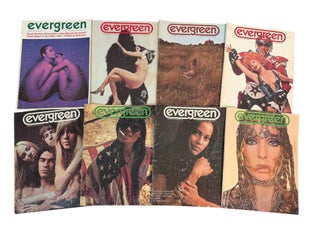
American counterculture magazine group from November 1969 through October 1970, documenting Evergreen Review as it brought experimental literature into direct contact with Black radical politics, the New Left, sexual liberation, environmentalism, censorship, and revolutionary cinema. Founded by Grove Press publisher Barney Rosset in 1957, Evergreen had developed by the end of the 1960s from a literary review associated with Samuel Beckett, Jean Paul Sartre, the Beats, and international avant garde writing into a large format illustrated monthly addressing the political conflicts and visual culture of the American counterculture. These eight issues begin with the November 1969 number and its coverage of Easy Rider, then extend across 1970 through articles including Julius Lester’s “The Black Writer and the New Censorship,” Nat Hentoff’s “Keeping Ecology Alive,” and Kent E. Carroll’s “Film and Revolution: An Interview with Jean Luc Godard.” The sequence records a magazine treating cinema, racial politics, environmental crisis, censorship, literature, and sexuality as parts of the same contemporary cultural struggle.Evergreen Review. New York: Evergreen Review, Inc., 1969 to 1970. Eight issues:
[1] No. 72, November 1969, with cover references to Donald Newlove, Dotson Rader, Julian Mitchell, Nat Hentoff, Dennis Hopper and Easy Rider, and a portfolio by Kishin Shinoyama; the issue includes L. M. Kit Carson’s treatment of Easy Rider, a film that had entered American theaters that year as a defining representation of countercultural mobility and generational conflict.
[2] No. 75, February 1970, contents include an interview with Zelimir Zilnik, an article on LeRoi Jones, Jean-Francois Jonvel's photography portfolio, book reviews.
[3] No. 76, March 1970, contents include Bill Amidon's "Cannonball Catchers," Michael Rumaker's "For Charles Olson," an interview with Jaromil Jires, Raymond Bertrand's erotic drawings.
[4] No. 77, April 1970, contents include an article on censorship of black radicalism, an article on environmentalism, Arthur Freed's photography portfolio, Bill Price's "Jimmy's Home."
[5] No. 79, June 1970, contents include poems by black dhildren, an interview with Fred Baker, article on the double standards of justice by Bobby Seale.
[6] No. 80, July 1970, contents include Allen Ginsberg's "Memory Gardens," Samuel Beckett's "Lessness," an interview with Nagisa Oshima, commentary on Native American oppression.
[7] No. 82, September 1970, containing material addressing the Chicago Conspiracy Trial and an interview concerning Jean Genet and the Black Panthers, alongside Julius Lester and Nat Hentoff.
[8] No. 83, October 1970, including Kent E. Carroll’s “Film and Revolution: An Interview with Jean Luc Godard,” material by R. Buckminster Fuller and Dziga Vertov, and Hentoff’s writing on ecology.
The group spans the year in which the American counterculture confronted an increasingly interconnected set of political questions: the Vietnam War and antiwar movement, Black liberation, political trials and state power, censorship, ecology, and the relationship between revolutionary politics and mass culture. Evergreen Review approached these subjects through the same publishing program that Grove Press had used to contest literary censorship and introduce international avant garde writing to American readers. By 1969 and 1970, that program had expanded into a magazine whose typography, photography, erotic imagery, and political illustration were themselves arguments about the limits of mainstream publishing. Covers and extremities show moderate rubbing, creasing, handling wear, occasional soiling, and edge wear; issue 75 has water damage to front cover causing partial fusion of first page; issue 79 covers partially detached on lower half of spine; interiors generally clean and complete. Overall good condition.Eight issues tracing Evergreen Review from the countercultural mythology surrounding Easy Rider in late 1969 through the Black politics, censorship debates, environmentalism, sexual experimentation, and revolutionary cinema that occupied its pages during 1970.
Item #23882
Price: $485.00
See all items in Other (Literature), Counterculture, Popular Culture, Social Activism
See all items in Literature & Literary Archives, Mass Media & Popular Culture, Social Activism & Protest
See all items by Evergreen Review Archive
Suggested CountercultureBrowse All




Suggested Popular CultureBrowse All


Suggested Social ActivismBrowse All



Suggested Other (Literature)Browse All

![Women’s Suffrage] [Abolition] Julia Ward Howe Autograph Letter on Speaking Engagements and. Julia Ward Howe.](https://maxrambod.cdn.bibliopolis.com/pictures/16028.jpg?width=320&height=427&fit=bounds&auto=webp&v=1623976896)