Chinese Street Commerce, River Labor, and Everyday Life in Peking and Northern China: Late Qing to Republican Era, circa 1900–1920s
Photograph
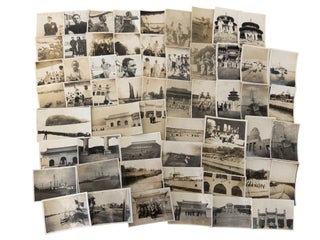
Peking and northern China photographic archive documenting everyday commerce, informal labor, transportation, and waterfront life during the final Qing and early Republican periods, circa 1900 to the 1920s. Rather than concentrating on monuments or official events, the photographs turn repeatedly toward merchants, barbers, vendors, boatmen, fishermen, cart drivers, and working streets. French manuscript captions identify Peking, Tien Tsin, and other northern Chinese locations, suggesting a Francophone traveler recording the commercial and social landscape encountered along the route. Early twentieth century photographs of China survive in substantial institutional collections, but small groups centered on ordinary economic activity and working neighborhoods like this one are less frequently encountered than architectural, military, and tourist views.Photo archive of 23 sepia toned silver gelatin photographs, ranging from approximately 2 x 3 to 3 x 4 inches, Peking, Tien Tsin, and northern China, circa 1900 to the 1920s. The photographs show merchants displaying wares in open air markets; a street barber attending a seated customer; vendors working from tables, baskets, and temporary stalls; men gathered around cooking vessels beneath makeshift shelters; horse and donkey carts carrying goods; fishermen and boatmen among crowded wooden craft; and waterfront workers loading or unloading vessels. River and harbor views record dense concentrations of sampans and other small boats beside wooden landings, while street scenes show carts, animals, warehouses, a water tower, and commercial traffic moving through the same urban environment. French inscriptions on the versos identify subjects and places including “Pékin marché,” “Pékin restaurant en plein air,” “Tien Tsin,” “Tien Tsin rue Dillon,” “voiture chinoise,” and “port de bateaux français.” Other captions appear to identify Chin Van Tao, possibly an early romanization of Qinhuangdao, though that reading remains uncertain. Several photographs carry French captions written directly in the negative or along the lower edge, providing contemporary identifications of the scenes and further associating the group with a Francophone traveler or photographer.
The photographs span the final years of the Qing dynasty, the 1911 Revolution, the establishment of the Republic in 1912, and the subsequent Republican period, when Peking remained a major political and commercial center. After the Qing abdication in February 1912, Peking became the seat of Yuan Shikai's government and remained the principal seat of the Beiyang government until 1928. The material culture recorded here changed more slowly than the political institutions around it: carts, animal transport, open air markets, small trades, river traffic, and neighborhood commerce continued to structure daily life. The French captions also broaden the archive beyond Peking, connecting the capital to Tien Tsin and northern Chinese waterways and ports. Light to moderate surface wear, occasional spotting, edge wear, minor creasing, and varying degrees of fading and toning; manuscript verso inscriptions remain generally legible. Overall in very good condition. A concentrated visual record of merchants, boatmen, barbers, vendors, transport workers, markets, and waterways sustaining everyday economic life in northern China across the late Qing and early Republican eras.
Item #23887
Price: $1,450.00
See all items in World Culture & Travel, Travel & Cultural Photography, Vernacular & Community Photography, China
See all items in International & Global Culture, Photography, World History by Geography
See all items in China
Suggested ChinaBrowse All



Suggested PhotographyBrowse All




Suggested World History by GeographyBrowse All