Tuskegee Airmen Overseas Service & Black Military Life in World War II: Photo Archive of 14 Items, 1944–1945
Photograph
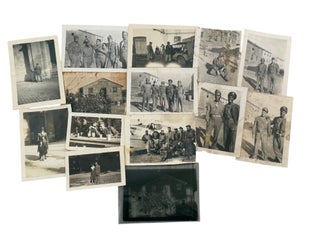
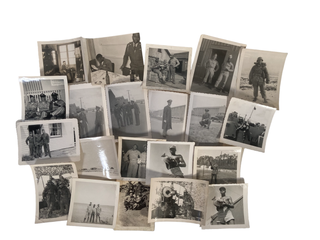
Tuskegee Airmen wartime photo archive depicting African American Army Air Forces servicemen during the Second World War, circa 1944 to 1945, recording the personal and military environment of Black aviation personnel serving within a segregated U.S. armed forces. The photographs belong to the wartime world created by the Tuskegee program, which trained Black pilots and supporting personnel for military aviation at a time when Army policy maintained racial separation in training, housing, recreation, and unit organization. Overseas service brought Tuskegee trained personnel into the Mediterranean and European war, where the 332nd Fighter Group entered combat from Italy in 1944 and the 99th Fighter Squadron subsequently joined the group. Rather than concentrating on formal combat photography, the archive records the men themselves, their friendships, uniforms, quarters, vehicles, aircraft, and the places through which they moved.Photo archive of 14 photographic items, comprising 13 silver gelatin photographs and one photographic negative, circa 1944 to 1945. The photographs show African American servicemen individually, in pairs, and in larger groups, several wearing Army Air Forces uniforms and overseas caps, with enlisted rank insignia visible on a number of uniforms. Several men pose outside long military buildings or barracks; another sits on the ground in uniform; and a series of closely related portraits records servicemen standing together in the same military compound. Other photographs show men on active duty with servicemen gathered beside a military Liberty Truck near a European building; men sit at an outdoor table with bottles and drinking vessels; a solitary uniformed man stands beside a masonry structure; and groups pose in front of a utilitarian wooden building. A particularly substantial group portrait shows approximately two dozen Black servicemen gathered before this building, with the same scene preserved as a negative, retaining both the positive print and its photographic source. Another photograph shows a large group of servicemen posed beside a military aircraft bearing the visible name "Gloria," connecting the informal portraits directly to the aviation setting. Several images appear consistent with overseas European or Mediterranean service, including the photographs of men beside military transport and masonry or stucco architecture, although the precise locations are not identified in the material.
The photographs date from the period in which the Tuskegee experiment moved decisively from segregated stateside training into combat operations overseas. The 99th Fighter Squadron entered combat in the Mediterranean in 1943, while the 332nd Fighter Group arrived in Italy in early 1944 and moved to Ramitelli Airfield that May; commanded by Benjamin O. Davis Jr., its fighter squadrons subsequently flew bomber escort and other combat missions from Italy. Their wartime service unfolded against explicit institutional segregation: the Army had created separate Black aviation units rather than integrating Black personnel into existing white units, making the daily lives recorded here inseparable from the larger struggle over African American participation in the armed forces. The performance and wartime experience of Black military personnel became part of the postwar debate over segregation in the services, preceding President Harry S. Truman's Executive Order 9981 of July 26, 1948, which declared equality of treatment and opportunity in the armed forces without regard to race, color, religion, or national origin. Light to moderate handling wear, creasing, staining, and occasional losses to the print margins; the group photograph corresponding to the surviving negative is substantially worn and creased. Else legible and generally clean. Overall in very good condition. A personal photographic record of Black Army Air Forces servicemen during the Tuskegee Airmen era, preserving the faces, associations, military surroundings, and overseas experience of African American servicemen whose wartime service coincided with the final years of formal segregation in the United States military.
Item #23869
Price: $2,800.00
See all items in African American Military Service, Alabama, World War II, Military & War Photography, Aviation
See all items in African American History, American History by State, Military & War, Photography, Space & Aviation
See all items by Tuskegee Airmen
See all items in Alabama
Suggested African American Military ServiceBrowse All






Suggested World War IIBrowse All



Suggested AviationBrowse All



Suggested AlabamaBrowse All