Northwest Airlines Flight 5 Crash Archive: Moorhead Disaster, Icing Conditions, and Prewar Commercial Aviation Safety, 1941
Photograph
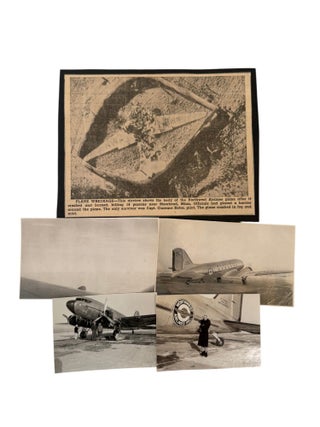
Northwest Airlines Flight 5 crash archive documenting one of the most deadly commercial aviation disasters in the carrier’s early history, pairing operational views of Northwest’s Douglas airliners with contemporary evidence from the fatal October 30, 1941 crash near Moorhead, Minnesota. Flight 5 was a scheduled transcontinental Northwest Airlines route traveling from Chicago toward Seattle through Minneapolis, Fargo, Billings, Butte, and Spokane when its Douglas DC-3A-269, registration NC21712, encountered severe icing and poor visibility during approach. The aircraft plunged to the ground in fog and freezing conditions, killing twelve passengers and two crew members. Captain Clarence F. Bates emerged as the sole survivor. The subsequent Civil Aeronautics Board investigation concluded that dangerous ice accumulation on the wings played a critical role in the disaster, making the crash an important chapter in the evolution of commercial aviation safety during the final weeks before America entered the Second World War.Archive of four silver gelatin photographs and a contemporary newspaper clipping, photographs approx 3.5" x 5" to 5" x 7", circa 1941. The photographs capture Northwest Airlines aircraft in active service during the same period as the disaster. One image shows a Northwest airliner standing on a frozen airfield with registration number NC21711 visible on the tail and prominent “Northwest” and “U.S. Mail Air Express” markings along the fuselage. Another view depicts a woman posing beside the company’s large winged emblem, with mail and express service markings visible near the tail section. A third photograph records ground operations beneath a Northwest aircraft as personnel stand near a baggage cart marked “Shell,” illustrating the everyday routines of America’s growing commercial airline network. A final image looks outward from above an aircraft wing toward the horizon, placing the viewer inside the world of prewar air travel. The accompanying newspaper clipping dramatically contrasts these routine scenes with aerial views of the burned wreckage of NC21712 near Moorhead, identifying the disaster, the fourteen fatalities, the role of fog and icing, and Captain Bates’ remarkable survival.
The archive place the optimism and expansion of early commercial aviation beside the harsh realities of flying in an era when weather forecasting, radio navigation, aircraft de-icing technology, and long-distance passenger service were still developing. Created less than six weeks before the United States entered World War II, the archive captures Northwest Airlines at a pivotal moment when passenger travel, air mail contracts, and express cargo routes were rapidly connecting the Midwest, Northern Plains, Rocky Mountains, and Pacific Northwest. The juxtaposition of aircraft operating normally in service with contemporary documentation of Flight 5’s destruction transforms the group into more than a simple airline archive—it becomes a visual record of the risks, ambitions, and technological challenges of American aviation on the eve of wartime expansion.
Light handling wear, mild curling, toning, and creasing to the newspaper clipping; photographs remain very good. A tightly related aviation archive combining identifiable Northwest Airlines aircraft, visible registration numbers, airline operations, and one of the carrier’s most significant prewar disasters.
Item #23525
Price: $550.00
See all items in Minnesota, Natural & Industrial Disasters, Transportation Systems, Aviation
See all items in American History by State, Labor, Environment & Industry, Space & Aviation
See all items by Northwest Airlines Flight 5 Crash
See all items in Minnesota
Suggested AviationBrowse All




Suggested Transportation SystemsBrowse All




Suggested MinnesotaBrowse All



Suggested American History by StateBrowse All