African American Police Officers in Jim Crow Florida: Clearwater Police Department ; 18 George Fulmer Photographs and Large Format Negatives, Early 1950s
Photograph
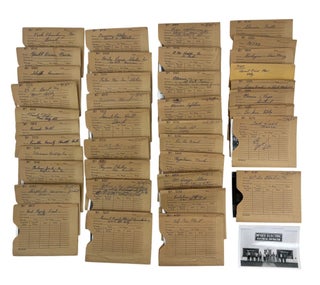
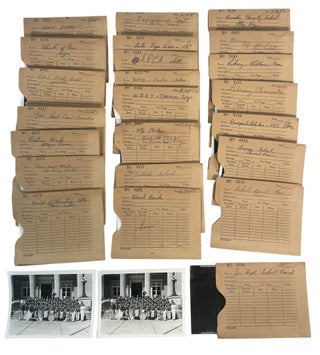
Clearwater, Florida's police department photo archive, early 1950s, documenting Black officers working within Clearwater’s municipal police force while the city continued to operate racially segregated municipal institutions and public facilities. Clearwater’s own historical account identifies Oscar “Sport” McCullom as one of the city’s first African American police officers, establishing that Black policemen had entered the department during the Jim Crow period. Elsewhere in Pinellas County, as documented in neighboring St. Petersburg, Black officers' authorities were confined to segregated Black districts, denied authority over white citizens, and separated from white colleagues in departmental facilities. By 1965, twelve St. Petersburg officers challenged those conditions in federal court, ultimately winning an appellate ruling in 1968 that dismantled discriminatory assignments and employment practices within that department. Fulmer’s earlier Clearwater photographs record Black men visibly wearing the uniform and participating in municipal law enforcement while the surrounding civic order was and would remain segregated for two more decades.Photo archive of 18 photographic items total including 9 silver gelatin photograph prints with 9 corresponding negatives, retained in 5 original George Fulmer studio envelopes with captions, Clearwater, Florida, early 1950s. Silver gelatin photograph prints ranging from 4.5" x 2."' to 5 x 4 inches, and each negative about 4 x 5 inches. The photographs were made during the administration of Chief George McClamma, who headed the Clearwater Police Department from 1949 through 1957. The strongest sequence shows two Black uniformed Clearwater police officers standing behind a Black man in work clothes at a barred booking counter while a white police sergeant completes paperwork in the foreground; wanted notices and departmental lockers fill the station wall behind them. Fulmer photographed the booking scene in at least two exposures, and the original envelope identifies the assignment simply as “Murder suspect.” A separate police assignment, captioned “Police Dept. diamond ring,” shows a Black man standing between two white men in suits, one holding a shovel and the other apparently displaying a small object, suggesting the documentation of recovered evidence without establishing from the photograph alone whether the Black man was a suspect, witness, employee, or other participant. Portrait assignments include a Clearwater police sergeant photographed in uniform beneath an envelope dated December 26 and identified with “McMullen” and “Capt.”; two portraits of an officer under envelope no. 4068, dated January 14, 1952 and captioned “Cox J. E. port.”; and a further civic safety assignments show uniformed official presenting an architectural model to a suited man. The numbered studio envelopes preserve Fulmer’s commercial job system and connect finished photographs with their corresponding negatives, retaining contemporary departmental language for assignments that would otherwise survive as unidentified police photographs.
The municipal employment of Black police officers did not indicate an integrated city government or an end to Jim Crow. It instead placed Black men in positions of state authority inside a civic system that continued to separate Black residents in education, recreation, access to public services, housing, and even burial. Florida evidence from the same period shows that this contradiction was not unique to Clearwater, as Miami began appointing Black officers in 1944, yet some African American policemen hired there as late as 1949 did not receive academy training until 1952. In 1964 Clearwater police officer Leon Bradley challenged the Pinellas County School Board after it refused to place his son in a white school; his federal lawsuit began an era of judicial supervision that culminated in countywide desegregation measures in 1971. Fulmer’s early 1950s photographs precede that litigation by more than a decade and record Black municipal officers already occupying the difficult institutional position between segregated Black Clearwater and the governmental authority enforcing order within the city. Light handling wear to the photographs and negatives, with creasing of envelopes and some curling oh photographs. Toning and wear to several original studio envelopes. Overall in very good condition. A concentrated photographic record of Black police employment, criminal processing, and municipal authority inside a Clearwater civic structure that remained explicitly segregated under Jim Crow.
Item #23826
Price: $1,250.00
See all items in Reconstruction & Jim Crow, Urbanization & City Development, Florida, Reconstruction & Jim Crow, Police & Law Enforcement, Vernacular & Community Photography
See all items in African American History, American History & Americana, American History by State, Civil Rights, Law, Incarceration & Public Policy, Photography
See all items by George Fulmer Sunbelt Migration
See all items in Florida
Suggested FloridaBrowse All




Suggested African American HistoryBrowse All





Suggested PhotographyBrowse All



Suggested American History by StateBrowse All