Japanese American Tsuto Kawakami’s Immigration, Wartime Incarceration, and Postwar Life archive in California, 1918-60s
Ephemera
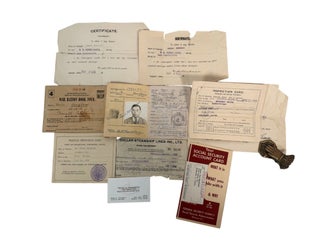
Tsuto Kawakami immigration and incarceration ephemera archive, 1918 to circa 1960s, documenting the administrative record of a Japanese Issei immigrant across transpacific travel, alien registration, wartime removal and incarceration, and postwar civilian life. Born near Kumamoto, Japan, on March 26, 1902, Kawakami first entered the United States in 1919 and by February, 1942 recorded twenty three years and two months of American residence, with an address in Concord, California. The papers preserve that history through documents generated by Japanese port authorities, steamship logs, the Federal Bureau of Investigation registration system, the Office of Price Administration, and the Social Security Administration. This archive is anchored by Kawakami's War Ration Book Four, issued to him at the camp style address “45-W-B, Newell, California.” Newell was the location of the Tule Lake Relocation Center, later designated the Tule Lake Segregation Center, where Japanese Americans were incarcerated beginning in 1942. The ration book connects Kawakami's prewar Concord registration to the federal machinery of wartime incarceration while the earlier travel papers document the mobility between Japan and California that preceded forced removal.Archive of 12 documents and pieces of ephemera belonging to Tsuto Kawakami, Japan and California, 1918 to circa 1960s, comprising immigration and passenger certificates, vaccination and medical inspection records, steamship documentation, an Alien Registration receipt booklet with portrait and fingerprint, an Office of Price Administration ration book, Social Security material, and retained business ephemera.
[1] Kawakami, Tsuto. Vaccination Certificate. Nagasaki, Japan, November 9, 1918. Issued for Kawakami as a passenger aboard the S.S. Korea Maru, bound for San Francisco, certifying vaccination before his voyage to the United States.
[2] Kawakami, Tsuto. Certificate of Inoculation Against Cerebro Spinal Meningitis. Nagasaki, Japan, November 9, 1918. Companion passenger certificate for the Korea Maru, certifying that Kawakami had been twice inoculated before departure for San Francisco.
[3] Kawakami, Tsuto. Vaccination Certificate. Nagasaki, Japan, August 20, 1922. Passenger certificate naming the S.S. Shinyo Maru and San Francisco as destination, with physician's signature and Nagasaki date stamp.
[4] Kawakami, Tsuto. Medical Inspection Card. Port of Departure, Nagasaki, Japan. Nagasaki, August 1922. Records Kawakami's last residence as Kumamoto ken, identifies the S.S. Shinyo Maru, and bears the stamp of the medical officer at Nagasaki.
[5] Kawakami, Tsuto. Inspection Card. Nagasaki, August 21, 1922. Immigration inspection document for the Shinyo Maru, recording Kawakami's departure from Nagasaki and “Kumamoto-ken” as his last residence, with alien consular inspection stamp.
[6] Kawakami, Tsuto. Vaccinated. Japan, circa 1922. Quarantine certificate intended to be retained by the traveler “to avoid detention at Quarantine and on Railroads in the United States,” with Japanese text and manuscript certification.
[7] Kawakami, Tsuto. Medical Inspection Card. Port of Departure, Yokohama, Japan. Yokohama, July 12, 1932. Names “Mr. Tsuto Kawakami,” gives his domicile as Kumamoto ken, identifies the ship as the Pres. Willson, and bears the seal of the Kanagawa prefectural medical inspection authority.
[8] Kawakami, Tsuto. Alien Tax Receipt. Dollar Steamship Lines Inc., Ltd., Yokohama, July 12, 1932. Receipt no. 26146 records Kawakami's passage from Yokohama to San Francisco aboard the S.S. President Wilson and payment of the eight dollar federal alien tax required upon entry.
[9] Kawakami, Tsuto. Alien Registration Receipt Card. United States Department of Justice, 1942. Folded identification booklet, Alien Registration No. 1986083, with mounted portrait, right index fingerprint, and Kawakami's signature; records his birth near Kumamoto on March 26, 1902, Japanese citizenship, twenty three years and two months' residence in the United States, Concord, California residence, and filing with the Federal Bureau of Investigation office in San Francisco. A Concord registration stamp is dated 1942.
[10] Kawakami, Tsuto. War Ration Book Four. United States Office of Price Administration, circa 1943 to 1945. OPA Form R-145, no. 354148 FM, issued to Kawakami at “45-W-B / Newell California.” Comparable War Ration Book Four material survives from other Japanese Americans incarcerated by the War Relocation Authority, including an example issued at Gila River.
[11] Kawakami, Tsuto. Social Security Account Card and explanatory folder. Federal Security Agency, Social Security Administration, Washington, D.C., postwar. Retained in the printed folder “Your Social Security Account Card / WHAT it is / WHAT you do with it / & WHY.” The presence of a Social Security account records Kawakami's participation in the federal Social Security system but does not establish United States citizenship; the account number is intentionally not reproduced here.
[12] Frank S. Tsukamoto and Associates business card. Berkeley, California, circa 1960s. Card for Frank S. Tsukamoto and Associates, “General Insurance and Real Estate,” at 1837 Ashby Avenue, Berkeley, retained among Kawakami's papers. Its presence establishes a later connection to a Japanese American real estate and insurance business in Berkeley but, without a deed, receipt, or correspondence, does not document a property purchase.
Kawakami's papers follow an immigrant generation that remained legally classified as aliens through decades of residence in California. His 1942 registration booklet is particularly explicit: Japanese citizenship, Concord residence, fingerprint, portrait, signature, physical description, and notification that a copy of his application had been filed with the FBI in San Francisco. The succeeding ration book relocates the same named individual from Concord to “45-W-B, Newell California,” the locality of the Tule Lake center; federal and institutional records identify Tule Lake at Newell and document rationing as part of the center's administration. The change from a civilian Bay Area address to a numbered Newell address supplies unusually direct material evidence of the wartime rupture in Kawakami's life, while the Social Security material and Berkeley business card extend the record into the postwar period without establishing either later naturalization or property ownership. Documents show expected handling and storage wear, with toning, folds, edge tears, chips and losses to several travel certificates, staining to the ration book, and wear to the Alien Registration booklet; stamps, signatures, portrait, fingerprint, and principal manuscript entries remain legible. Overall good condition. A personal bureaucratic record of an Issei immigrant whose documents move from voluntary Pacific crossings and federal alien registration to a numbered Newell address at Tule Lake and subsequent return to civilian life in California.
Item #23730
Price: $1,850.00
See all items in California, Japanese American Internment, Other (Asian American), World War II
See all items in American History by State, Asian American History, Military & War
See all items in California, Japan
Suggested Japanese American InternmentBrowse All


Suggested Other (Asian American)Browse All
Suggested World War IIBrowse All


Suggested CaliforniaBrowse All