Western Couple's Travel through Shanghai, Chefoo, and Northern China, 1930-38
Photograph
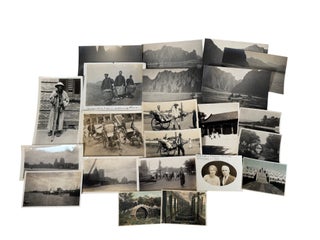
Western travel photo archive depicting Shanghai, Chefoo, Beijing, and northern Chinese landscapes, 1930 to 1938, recording the routes, attractions, and social encounters available to foreign travelers during the final decade before the Second Sino Japanese War transformed movement through coastal and northern China. The photographs move between the commercial modernity of Shanghai’s waterfront, the resort and treaty port environment of Chefoo, imperial architecture near Beijing, and river travel through mountainous terrain. Street portraits of rickshaw pullers, itinerant vendors, and an impoverished man also register the unequal relationship between foreign tourism and the Chinese labor on which it depended.Photo archive of 22 silver gelatin photographs, China, 1930 to 1938. ranging from 2 x 3 to 3.5 x 5 inches, Shanghai views show the skyline and harbor from the water, shipping along the waterfront, traffic near the Bund, rickshaw stands, and the Western couple seated in rickshaws beside their pullers. Other photographs depict men carrying large suspended baskets, two rickshaw pullers resting beside their vehicles, and a full length portrait bearing the printed caption “Chinese special beggar.” Northern views include the Summer Palace, its lake, bridges, balustrades, painted corridor, and hillside architecture; boat travel through steep, barren gorges; and broad river landscapes in which small craft are set against sharply eroded mountains. Handwritten versos identify “Summer Palace,” “Chefoo, No. China,” and “On the Bund,” with two photographs dated August 1938. A studio portrait is inscribed “Idabela + Father Main, Shanghai, 1930,” providing names for two members of the traveling party. Several prints carry additional captions en verso, including references to Chefoo and a multi day boat journey.
The archive belongs to the treaty port geography that structured much Western travel in Republican China. Shanghai’s Bund served as the monumental commercial frontage of the International Settlement, while Chefoo, now Yantai, had developed through foreign trade, consular activity, missionary residence, and seasonal tourism. The Summer Palace offered travelers a carefully preserved landscape of Qing imperial architecture and garden design outside Beijing, here photographed through its corridors, bridges, lake, and elevated buildings. The photographs preserve both the travelers’ itinerary and the visual categories through which foreigners encountered China: modern port, imperial monument, dramatic landscape, hired transport, street labor, and poverty presented as a tourist subject. Light surface wear, occasional creasing and edge wear, mild toning, and some fading; several versos inscribed in pencil or ink. Overall in good condition. A firsthand record of Western mobility through Republican China and of the Chinese workers, urban spaces, historic sites, and transport networks encountered along the route.
Item #23693
Price: $550.00
See all items in Imperialism & Colonialism, World Culture & Travel, Travel & Cultural Photography, China
See all items in International & Global Culture, Photography, World History by Geography
See all items by 1930 China Photo Archive
See all items in China
Suggested ChinaBrowse All




Suggested PhotographyBrowse All


Suggested World History by GeographyBrowse All