U.S. Navy Imperial Power in Cuba and Guantánamo Bay, Photograph Archive, 1914 to 1919
Photograph
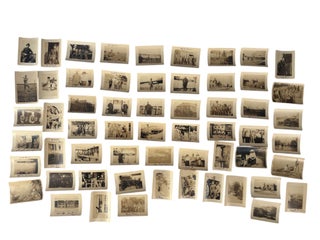
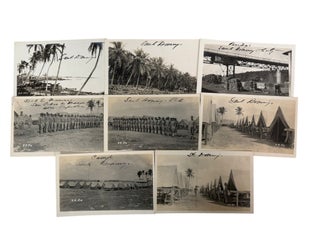
US Navy photograph archive, 1914 to 1919, documenting American sailors in Cuba during the years when Guantánamo Bay served as a U.S. naval station for Caribbean fleet activity, training, and strategic movement. Verso inscriptions reading “25wyn” and “1914 to 1919” likely connect the group to USS Wyoming (BB 32), whose documented service placed the battleship repeatedly in Cuban waters during this period. The photographs provide a sailor’s vernacular record of Cuban streets, roads, transportation, local residents, agricultural hauling, commerce, and infrastructure within a wartime Cuba shaped by U.S. naval presence, Caribbean patrol activity, and the uneven modernization of industry under US Imperial rule.Photo archive of 14 silver gelatin photographs, various sizes, most approximately 5 x 3.5 inches, Cuba, 1914 to 1919. The images show U.S. Navy sailors posed among cactus and agave, standing with Cuban men beside an open touring automobile, and gathered in uniform at a public outdoor event with benches, crowds, buildings, and hills beyond. Cuban infrastructure appears throughout the group: horse drawn carriages and wagons move through a town street lined with utility poles and commercial buildings; an ox team pulls a high wooden cart loaded with cut cane or brush along a rural road; a windmill or water pumping structure stands beside a group of local residents; a rail or tram line runs through a lightly built district; and a roadside scene combines naval uniforms, automobile travel, and undeveloped terrain. One commercial view shows a tourist photography and souvenir stand advertising “post cards made while you wait,” “souvenirs & novelties,” “Kodak films for sale,” and “photo printing developing,” placing commercial image making, tourist exchange, and modern photographic supply in the same Cuban landscape the sailors moved through during the US's imperial organization.
The U.S. naval presence in Cuba began with the Spanish American War and the occupation that followed. The Platt Amendment, which limited Cuban sovereignty after independence in 1902, and the 1903 lease agreements gave the United States a permanent base at Guantánamo Bay. By World War I, Guantánamo was part of the working map of U.S. power in the Caribbean. It supported fleet exercises, patrol movements, and regional security from Cuban territory. These photographs show US imperial interest by depicting American sailors moving through streets and roads where motorcars, utility poles, photographic shops, horse drawn traffic, ox carts, windmills, rural tram lines, and agricultural hauling all appear in the same landscape. Overall in good to fair condition, with heavy image fading, slight handling wear, some curling. Some photographs have tears which do not obstruct the images. A visual record of U.S. naval presence in Platt Amendment Cuba and the roads, shops, vehicles, animals, and rural working systems during the World War I period.
Item #23556
Price: $550.00
See all items in Imperialism & Colonialism, Transportation Systems, World War I, Caribbean
See all items in International & Global Culture, Labor, Environment & Industry, Military & War, World History by Geography
See all items by US Navy Sailors in Cuba
Suggested World War IBrowse All




Suggested Transportation SystemsBrowse All





Suggested CaribbeanBrowse All



Suggested World History by GeographyBrowse All