

Letter from Missouri Lawyer Opposing Slave Emancipation in North Carolina Estate, 1852
Manuscript & Autographs
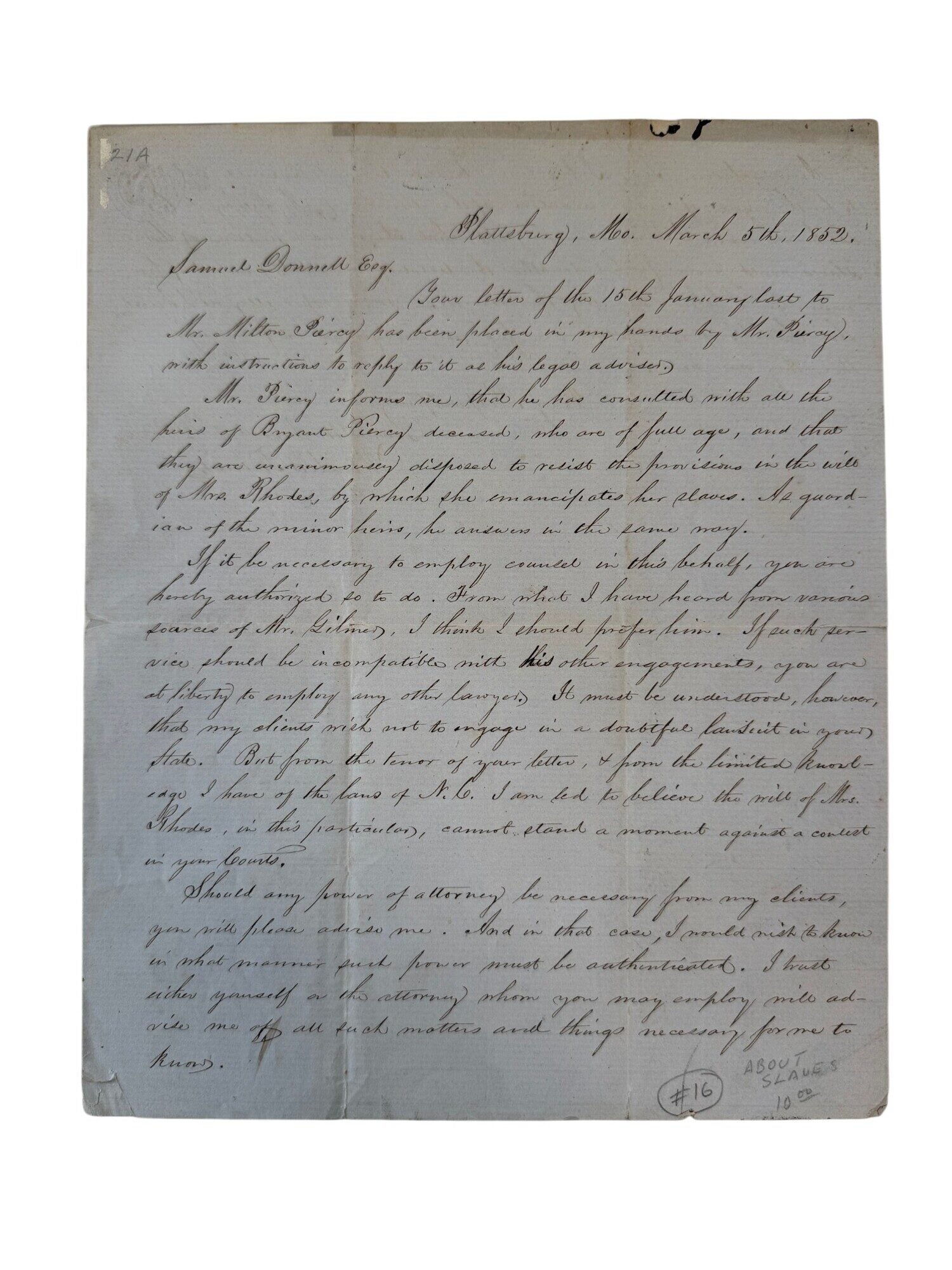
[Slavery & Abolition] In 1852, Winslow Turner, a Missouri lawyer, wrote to Samuel Donnell in North Carolina about a contested will. Mrs. Rhodes had died leaving a provision that would free enslaved people she held, but the heirs of Bryant P. Ewing claimed an interest in the estate and wanted that provision defeated. Milton Fary, acting for those heirs and as guardian of a minor heir, asked Turner to answer Donnell’s inquiry and give legal instructions. Turner reports that the adult heirs were “unanimously disposed to resist” the emancipation clause, authorizes Donnell to hire North Carolina counsel, and names Mr. Gilmer as the preferred lawyer. In the final paragraph, Turner argues that blocking emancipation would be “an act of true humanity,” because North Carolina’s laws against free Black people were, in his view, harsher than Missouri’s.Turner, Winslow. Autograph letter signed to Samuel Donnell, Esq. Plattsburg, Missouri, March 5, 1852. Two manuscript pages on folded laid paper. Turner writes as legal adviser to Milton Fary, guardian and representative of the Ewing heirs, and states that Mrs. Rhodes’s emancipation clause “cannot stand a moment” in North Carolina courts. The verso bears later docketing, including “Winslow Turner ansd,” “1852,” “Re Breaking a will of Mrs Rhodes,” and “#16 ABOUT SLAVES 10 00.” The entirety of the letter reads in full:
"Plattsburg, Mo. March 5th, 1852
Samuel Donnell Esq.
Your letter of the 13th January last to Mr. Milton Fary has been placed in my hands by Mr. Fary, with instructions to reply to it as his legal adviser.
Mr. Fary informs me, that he has consulted with all the heirs of Bryant P. Ewing deceased, who are of full age, and that they are unanimously disposed to resist the provision in the will of Mrs. Rhodes, by which she emancipates her slaves. As guardian of the minor heir, he answers in the same way.
If it be necessary to employ counsel in this behalf, you are hereby authorized to do so. From what I have heard from various sources of Mr. Gilmer, I think I should prefer him. If such preference should be incompatible with his other engagements, you are at liberty to employ any other lawyer. It must be understood, however, that my clients wish not to engage in a doubtful lawsuit in your state. But from the tenor of your letter & from the limited knowledge I have of the laws of N.C., I am led to believe the will of Mrs. Rhodes in this particular, cannot stand a moment against a court in your courts.
Should any power of attorney be necessary from my clients, you will please advise me. And in that case, I would wish to know in what manner such power must be authenticated. I trust either yourself, or the attorney whom you may employ, will advise me of all such matters and things necessary & proper to be known.
In conclusion, sir, I beg leave to remark, that I would not consent to be the organ of communication of the decision of Mr. Fary & the co-heirs, could I persuade myself that the emancipation of those slaves must prove (what doubtless the testatrix intended) an act of true humanity. I believe directly the reverse—more especially as I know that the laws of your state are far more rigorous on free negroes, than they are here.
Very Respectfully
Your Obt. Servant,
Winslow Turner"
The letter belongs to the antebellum legal world in which wills, guardianships, powers of attorney, and interstate counsel could be used to block private manumission. Turner’s language preserves both the procedural mechanics of the challenge and the moral argument used to justify it: the heirs seek to preserve enslaved property while claiming that freedom under North Carolina law would be more damaging than slavery. Folded as sent, with light toning, edge wear, small losses, and clear ink throughout; overall very good condition. A direct legal record of heirs organizing against testamentary emancipation nine years before the Civil War.
Item #23491
Price: $1,480.00
See all items in Slavery & Abolition, Missouri, North Carolina
See all items in African American History, American History by State
See all items by Manumission
See all items in North Carolina, Missouri
Suggested North CarolinaBrowse All


Suggested MissouriBrowse All



Suggested African American HistoryBrowse All



Suggested American History by StateBrowse All