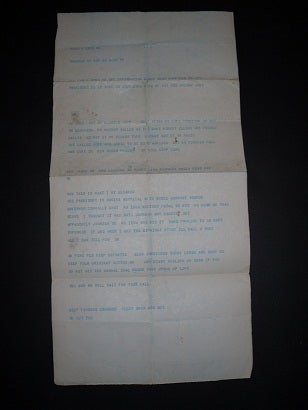
Cold War Political History Two Way Ocean Telegram Reporting Early News of the Assassination of President John F Kennedy 22 November 1963
Ephemera
Two way telegram exchange reporting early news of the shooting of President John F. Kennedy on November 22, 1963. The document records a live transatlantic communication between a passenger aboard a French Line ship at sea and a correspondent in the United States during the first hours after the assassination attempt in Dallas. Unlike standard wire service bulletins that transmitted news in a single direction, this document preserves a real time conversation in which individuals attempted to gather reliable information about the president’s condition as fragmented reports circulated. The exchange captures the uncertainty and disbelief that characterized the earliest public reactions to the attack on Kennedy during one of the most consequential political crises in modern American history.Wire type two way telegram printed on a single sheet measuring approximately 8½ x 17 inches. The document records a sequence of short exchanges between the ship and a contact on land. The correspondent at sea asks: “Can you give us any information about what happened to the President is it true or just some kind of not too bright joke.” The reply from the United States responds, “No joke but no details yet… just after he left downtown on way to luncheon.” Later messages attempt to summarize developing reports: “Now this is what I’ve gleaned. The President in hospital with three gunshot wounds Governor Connally shot no idea whether fatal or not… I thought it was both Johnson and Kennedy but apparently Johnson ok no idea who did it.” The exchange continues through several short paragraphs and concludes with the line “Keep fingers crossed,” reflecting the uncertainty surrounding the president’s fate during the first moments after the shooting.
The assassination of President Kennedy in Dallas on November 22, 1963 generated immediate global shock and produced a period of confusion as incomplete reports circulated through radio broadcasts, telephone calls, and telegraph networks. Documents that preserve contemporaneous reactions from ordinary observers illustrate how news of the event spread internationally and how individuals attempted to interpret fragmentary information before official confirmations were issued. This telegram exchange provides a rare conversational record of those first uncertain hours as Americans and others abroad tried to understand the unfolding national tragedy. Expected fading of the telegram text with fold lines and scattered staining typical of telegraphic paper. Overall condition good.
Item #13668
Price: $750.00
See all items in U.S. Presidents & Politicians, Texas, Cold War & Nuclear History
See all items in American History & Americana, American History by State, Military & War
See all items by John F. Kennedy Assassination
See all items in Texas
Suggested TexasBrowse All




Suggested American History by StateBrowse All