Bakke Decision Archive on Supreme Court Decision that Paved the Way for Affirmative Action, 1977-1978
Archive
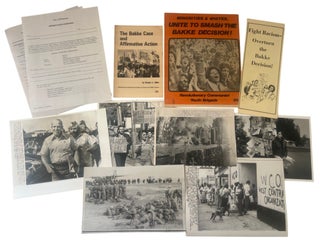
Bakke-era affirmative action and anti-racist organizing pamphlets, press photographs, and municipal employment forms which preserve how the 1977-1978 Regents of the University of California v. Bakke fight extended beyond the Supreme Court into university admissions, public hiring, and school desegregation, documenting the political language and administrative practice surrounding one of the central U.S. education cases of the late twentieth century. Placing the Supreme Court case within a broader struggle over school desegregation, minority access to higher education, and the public language of “reverse discrimination.” The archive tracks affirmative action as a public controversy argued simultaneously in Supreme Court litigation, street protest, municipal personnel paperwork, press photography, and local organizing.Archive of 10 items including 6 original silver gelatin press photographs, 3 original Affirmative Action pamphlets, and one City of Pomona employment form. The pamphlets preserve the movement language of the Bakke fight in sharply different registers: Robert L. Allen’s The Bakke Case and Affirmative Action states that “the past several years have been marked by growing racist reaction in the United States, especially in the field of education,” then develops sections titled “Institutional Racism and ‘Reverse Racism’” and “Affirmative Action and Racial Inequality,” while Minorities & Whites, Unite to Smash the Bakke Decision! carries on the verso the call to “fight all attacks on oppressed nationalities! fight imperialism and the source of oppression! revolutionary communist youth brigade.” The photographic and press-caption material extends the archive beyond the Supreme Court case itself: one print identifies Allan Bakke at UC Davis on 28 June 1978; another preserves Milwaukee desegregation protest signs reading “EQUAL RIGHTS FOR ALL!!” and “WHITE CHILDREN HAVE RIGHTS TOO!!!”; another carries a 25 July 1967 press clipping on federal troops entering Detroit; another identifies “Brian Baker, a native American Indian,” in a printed caption on affirmative action and Stanford; and another records West Central Organization activity beside a wall lettered “W.C.O. WEST CENTRAL ORGANIZATION.” The City of Pomona material includes an Application for Employment, an instruction sheet from the Personnel Department at 505 S. Garey Avenue, and an Affirmative Action Questionnaire asking applicants to identify sex, ethnicity, disability status, special accommodation needs, and how they learned of the job, with the form stating that the city is “committed to taking affirmative steps to ensure that minorities and women are adequately represented in the City’s work force.”
Bakke’s challenge to the UC Davis medical school admissions program became a national vehicle for the language of “reverse discrimination,” and these materials preserve the counterargument in the vocabulary of anti-racist organizing, from Allen’s discussion of institutional racism to pamphlet slogans demanding jobs and education for minorities. Light to moderate handling wear across the group; pamphlets toned and creased, Pomona forms clean with expected age toning, press photographs with agency labels, clippings, stamps, and minor surface wear. A concentrated documentary group on how affirmative action moved from court case to movement print, bureaucratic form, and to urban violence and federal troop deployment that followed one of the largest uprisings of the civil rights era, extending its affirmative action material into the earlier crisis of racial inequality, policing, and state response.
Item #23294
Price: $550.00
See all items in Black Radicalism & Activism, Reconstruction & Jim Crow, Michigan, Reconstruction & Jim Crow, Law & Public Policy, Radical Activism
See all items in African American History, American History by State, Civil Rights, Law, Incarceration & Public Policy, Social Activism & Protest
See all items by Affirmative Action Supreme Court Bakke Decision
See all items in Michigan
Suggested Radical ActivismBrowse All





Suggested MichiganBrowse All




Suggested African American HistoryBrowse All


Suggested American History by StateBrowse All