


WWII Pacific Demobilization Route of Identified Soldiers Aboard the USS General H.B. Freeman, Album of 338 Photographs, 1945
Photograph
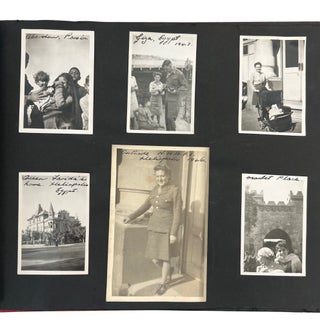
USS General H. B. Freeman album compiled by Emerson A. Wallace, 1945, documenting the first wartime voyages of the Coast Guard manned Navy transport AP 143 as it carried troops, ship personnel, and military passengers through the final months of World War II and the opening phase of occupation travel in the Pacific. Commissioned at Portland, Oregon on April 26, 1945, the Freeman sailed from San Pedro on June 1 with more than 3,000 passengers, reached Calcutta on July 9, moved through Ceylon, Australia, New Guinea, the Philippines, Okinawa, Saipan, Pearl Harbor, and the West Coast, and later transported occupation troops to Tokyo and Yokohama.Photo album of 338 silver gelatin photographs, Various sizes, most range from 2.5 x 3.5" to 4.5 x 6", Pacific, Australia, India, Japan, and the American West Coast, 1945. Brown embossed album covers with photos cornered in on black leaves. Many photos include captions identifying persons, events, and locations. The album includes the Freeman’s commissioning invitation naming Barbara Figel, a “Domain of the Golden Dragon” certificate dated June 12, 1945, shipboard offices, galley scenes, barbershop, photo lab, Coast Guard insignia transfers, boxing matches, entertainers aboard ship, servicewomen performing clerical work, and named shipmates including Lt. R. C. Sweeney and S. Fisher, commanding officer amongst others. Military movement appears through troops boarding and debarking, a Chinese Army officer boarding, deck drills, guns at sea, Saipan, Okinawa, Fremantle, Yokohama, San Pedro, and views of the ship itself. India is recorded through Calcutta, the Taj Mahal, Jain temples, street scenes, village life, a snake charmer, bathers, barbers, and an animal sacrifice at a temple. Japan includes shrines, temples, Yokohama harbor, city streets, and heavily damaged urban districts captioned “Bombed Section of Yokohama” and “Water Ruins Yokohama.”
The album places one enlisted man’s record inside the machinery of late war transport, demobilization, and occupation travel, when troopships became moving administrative spaces carrying soldiers, Marines, Coast Guardsmen, clerks, entertainers, mail, ceremony, and returning veterans across the Pacific. The Freeman’s route captures the war’s abrupt transition from active Pacific deployment to occupation and demobilization. Calcutta places the ship in Allied India before Japan’s surrender, when men and matériel were still being routed through the China Burma India theater and the Indian Ocean. Okinawa is especially significant because the Freeman arrived at Hagushi on August 16, 1945, one day after hostilities ended, turning a battle-scarred invasion anchorage into an embarkation point for homeward-bound veterans. Saipan and Pearl Harbor then mark the return chain across the Pacific, part of the same transport network later known as “Magic Carpet.” Yokohama shifts the album into occupied Japan: American personnel moved through a devastated port city where bombing damage, harbor activity, troop movement, and Japanese urban life existed side by side under U.S. military authority. photographs generally clear with some fading, silvering, adhesive marks, corner wear, and scattered album page wear. Overall in good condition.
Item #23427
Price: $950.00
See all items in Other (American History), Other (International), World War II, Military & War Photography
See all items in American History & Americana, International & Global Culture, Military & War, Photography, Archive
See all items by USS General H. B. Freeman
Suggested World War IIBrowse All



Suggested Other (American History)Browse All
Suggested Other (International)Browse All





Suggested PhotographyBrowse All


