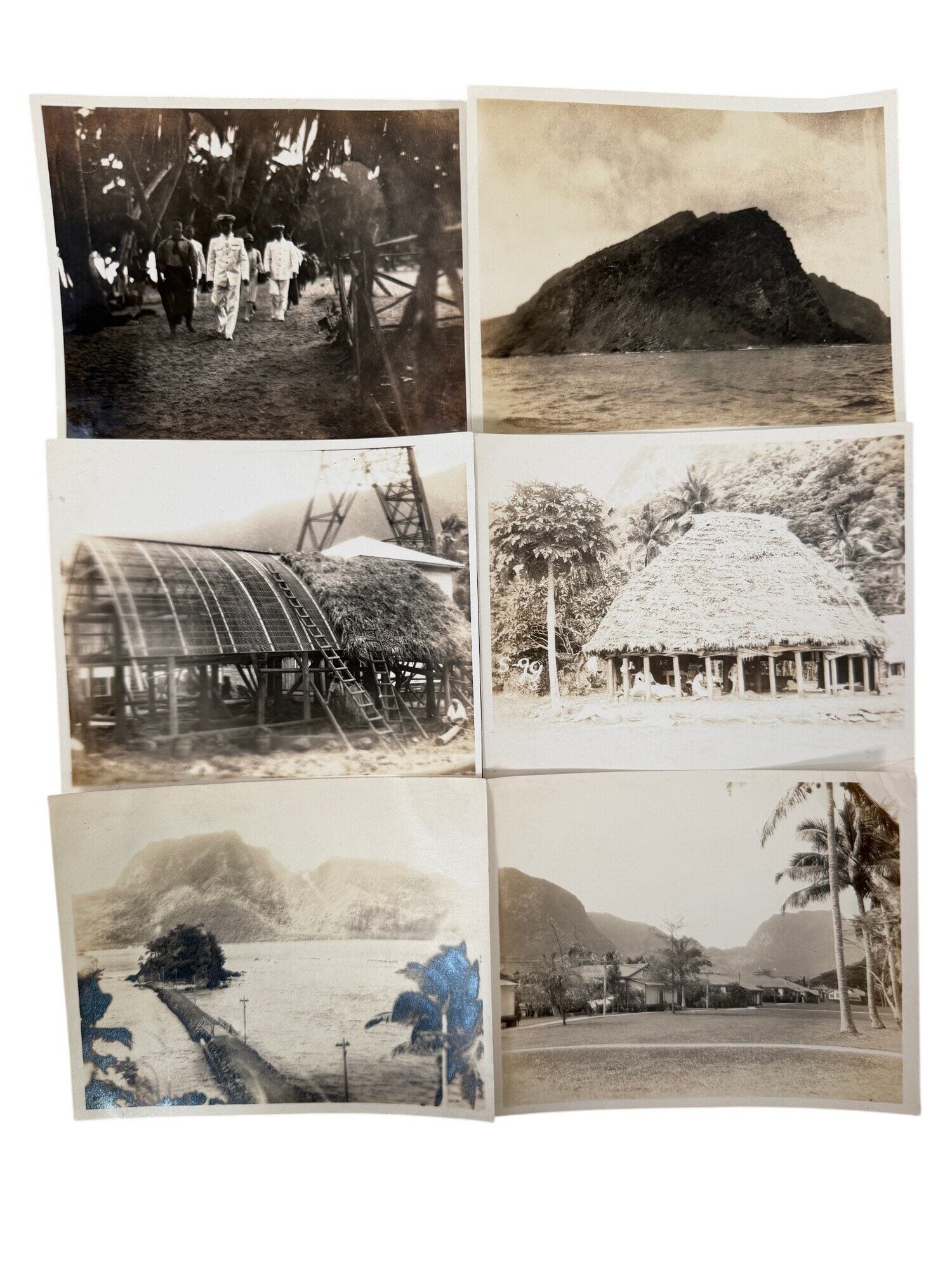


Interwar Samoa under U.S. Naval Rule, Village Life, Harbor Infrastructure, and Colonial Space, 1928
Photograph
Samoa photo archive documenting villages and locals during the U.S. colonial administration in 1928. Several inscriptions identify Tutuila, Manua, Utulei, Leone, and Pago Pago Bay, while one captioned view explicitly notes a native governor in white and the American governor during an inspection, placing the group within the administrative system through which the United States governed the territory after the 1900 cession. The photographs hold political authority, missionization, settlement patterns, and everyday Samoan built space in the same frame, making the archive useful not simply as island scenery but as evidence of colonial order in practice.Photo archive of 15 black and white photographs, ranging from 2.75" x 4" to 3.5" x 5", Samoa, 1928. Many versos carry contemporary manuscript captions, including "Inspecting at Tai, Manua," "Pago Pago Harbor," "Native house under construction, Tutuila," "Native life at Utulei," "Goat Island, Pago Pago Bay," "Officers Row, golf course in foreground," and "Church at Leone." The images show multiple Samoan fale, including large round and oval thatched structures raised on posts, one photographed mid-construction with exposed framing and ladder in place. Other views record a white church facade at Leone, broad mountain backed harbor scenes, a shoreline road or causeway leading into the bay, and a landscaped government or residential quarter with palms and open lawn. Several photographs depict indigenous groups assembled on a large field engaging in traditional ceremony. A particularly revealing image shows colonial officials and attendants moving beneath dense palms, with the caption identifying both the native governor and the American governor and directly marking the dual structure of authority under U.S. rule.
In the interwar period, Samoa remained under U.S. naval administration, with Pago Pago functioning as the territory's strategic harbor and administrative center while village life, chiefly authority, mission Christianity, and a small export economy continued under colonial supervision. These photographs show that dichotomy through officers' housing and golf ground and mission church architecture to local village life and ceremony. Light edge wear, minor curling; manuscript captions generally clear and legible. Overall very good condition. This archive captures Samoa as a colonized Pacific territory in which village life, ceremonial gathering, religious architecture, and colonial rule entangled.
Item #23254
Price: $850.00
See all items in Samoa, Imperialism & Colonialism, Imperialism & Colonialism, Military & War Photography
See all items in American History by State, International & Global Culture, Military & War, Photography, Archive
See all items by U S. Navy in Samoa
See all items in Samoa
Suggested SamoaBrowse All

Suggested PhotographyBrowse All




Suggested ArchiveBrowse All





Suggested American History by StateBrowse All