


Colonial India during World War II Captioned Photo Archive of Weapons Training, and Mandu Excursions, 1942
Photograph
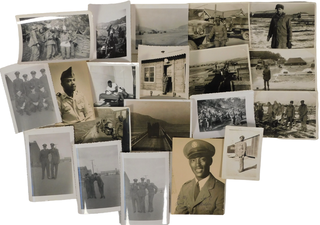
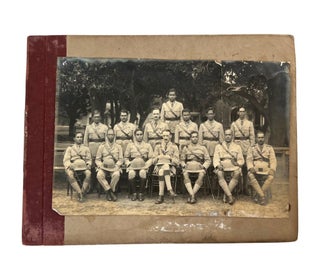
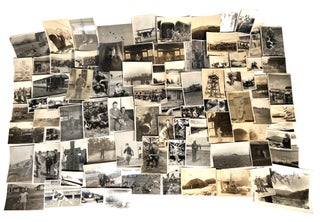
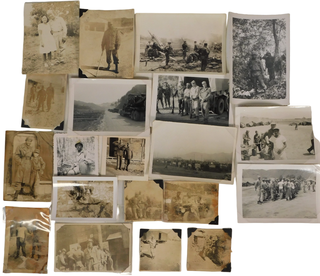
British India photo archive following an unidentified man, likely a serviceman, in Mhow and Mandu during World War II, 1942-1943, preserving a localized record of colonial wartime life through mess scenes, sport, staff bungalows, named companions, imposed colonial social frameworks, and visits to the major Islamic monuments of Mandu. The captions place the central figure in the company of “Carroll Sahib," Ken Davis, and other men in uniform-style dress, while repeated references to the "mess," weapon training staff, and cantonment-like grounds situate the photographs within a British colonial wartime environment in central India. The group shows one participant moving between military or officer-adjacent daily life and the monumental landscape of Mandu at a moment when India remained a crucial base of Allied wartime activity.Photo archive of 43 silver gelatin photographs, ranging from 2 x 3.5 to 2.5 x 2.5 inches, Mhow and Mandu, India, 1942-1943. Most photographs bear substantial contemporary handwritten inscriptions on the versos, often dated. Identifiable scenes include two men with tennis rackets outside a bungalow captioned as taken after tennis; a portrait inscribed “Me, the Carroll Sahib & Ken Davis outside the Mess 25/12/42”; a group of eight men captioned “two scotsmen, our four weapon training instructors, the Carroll Sahib + me outside the W/T staff bungalow, 25/12/42”; men wearing garlands outside the mess; a sports or gymkhana ground with riders or runners in formation; tented grounds beside a large building; and a portrait of a man identified as “Machdo, our bearer.” The architectural and landscape views are closely tied to Mandu, with captions naming the Jami Masjid, Jahaz Mahal, Rupmati’s Pavilion, Baz Bahadur’s Palace, mosque interiors, courtyards, pools, lake views, ravines, and elevated plateaus. Several photographs show men posed on open parade or sports grounds in light uniform-style dress, including group portraits outside the mess and the W/T staff bungalow, with tennis rackets, bicycles, garlands, and temporary tent lines indicating a social world organized around exercise, communal dining, and station routine. Other images turn to Mandu’s built landscape in much greater detail, with framed views of domed pavilions, arcaded courtyards, carved entrances, long interior corridors, water tanks, and palace ruins seen from terraces, lakesides, and elevated lookouts. The landscape scenes broaden that record further, including steep ravines, river and waterfall views, and plateau panoramas that place the serviceman’s movements within the wider terrain of central India.
During World War II, Mhow remained an important cantonment in British India, and these photographs place one serviceman within the daily social world of that station, where tennis, communal dining, staff housing, local attendants, and holiday gatherings existed alongside travel to nearby historic sites. The Mandu views record the same hand moving through one of central India’s best-known Sultanate monument complexes, with captions naming the Jami Masjid, Jahaz Mahal, Rupmati’s Pavilion, Baz Bahadur’s Palace, and associated interiors, courtyards, pools, and landscape features. Light general wear, occasional silvering, and minor handling marks; inscriptions strong and legible on most versos. The dense captioning and photographic record show British colonial India during World War II, through the the personal lens colonial rank and language, staff organization, sport and leisure during wartime, Indian attendants, and movement through one of central India’s historic architectural landscapes.
Item #23216
Price: $550.00
See all items in Imperialism & Colonialism, World War II, India
See all items in Military & War, World History by Geography, Archive
See all items by British Colonial India
See all items in India
Suggested World War IIBrowse All





Suggested IndiaBrowse All




Suggested World History by GeographyBrowse All

Suggested ArchiveBrowse All


