Japanese Surrender and U.S. Occupation in Okinawa, an Armyman's Photo Archive 50 silver gelatin prints Documenting Postwar Transition, Civilian Populations, and Imperial Collapse, 1945
Photograph
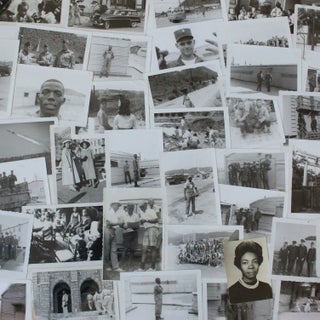
[Japanese] [Pacific Theater] WWII serviceman’s photo archive titled “Scenic & Souvenir Pictures from Okinawa Jima,” 1945, documents the final destruction of Okinawa and the immediate political aftermath of U.S. military occupation at the moment of Japan’s surrender. The American serviceman was likely stationed on Okinawa between August and October 1945. The photographs record the infrastructural devastation of the Battle of Okinawa, the opening phase of U.S. occupation, and the civilian populations of the Ryukyu Islands in the weeks surrounding Japan’s formal surrender on September 2, 1945. The accompanying typed caption sheet opens with the entry, “Korean girls used by the Japs as geisha and house girls,” documenting the forced labor and sexual exploitation of Korean women in the Japanese imperial system prior to its postwar denial. The language used throughout the caption sheet displays the racist terminology through which American servicemen interpreted Japanese, Korean, and Okinawan populations during the pivotal months of WWII's conclusion.Archive of 50 silver gelatin prints, approximately between 3" x 4" and 3.5" x 5.5", individually numbered in manuscript to correspond with an original typed caption sheet. August through October 1945, across Okinawa Jima and Ie Shima, Japan. The images document extensive battle damage, including the ruins of Shuri Castle, destroyed churches at Shuri and Naha, railway wreckage, leveled villages such as Uibaru, and panoramic views of Naha. Military and commemorative sites include the grave of General Simon Bolivar Buckner Jr. in the 7th Division Cemetery and the grave of war correspondent Ernie Pyle on Ie Shima. Additional groupings depict Buckner Bay and Chimu Wan following the October 9, 1945 typhoon; destroyed Japanese landing craft; Shinto shrines and Okinawan burial tombs with explanatory captions; and Okinawan civilian life, including ration distribution at the Ishikawa Ration Board, water collection, terraced rice agriculture, and labor performed under American supervision. Photographs 13 and 14 record members of the Japanese surrender delegation landing at Ie Shima on August 19, 1945, where they were transferred to U.S. transport aircraft en route to Manila to receive instructions concerning surrender and occupation arrangements. Produced by an American serviceman rather than an official military photographer, these images provide a ground-level view of the surrender process between Japan’s announcement of capitulation and the formal signing aboard the USS Missouri. Photograph 26 documents an intact Ohka rocket-powered kamikaze weapon at Yontan airfield, recovered during active combat in April 1945, when the scale of Japanese suicide attack strategy was still being assessed by American command.
Produced in the aftermath of one of the deadliest campaigns of World War II, the archive situates Japan’s surrender within a landscape of destruction, displacement, and occupation on Okinawa, where over 100,000 civilians were killed. The combination of surrender imagery, documentation of Korean exploitation, and visual evidence of infrastructural collapse places the material within overlapping histories of imperial violence, total war, and postwar realignment in East Asia. The typed caption sheet remains legible despite fold wear, edge losses, handling creases, and small tears; photographs show light curling and occasional fading consistent with field handling. Overall very good condition. A textually integrated photographic record that documents how the end of the Pacific War was witnessed and structured at ground level as American occupation authority was established.
Item #23060
Price: $1,250.00
See all items in World War II, Japan
See all items in Military & War, Photography, World History by Geography
See all items by U S. Occupation in Okinawa
See all items in Japan
Suggested World War IIBrowse All




Suggested JapanBrowse All




Suggested PhotographyBrowse All


Suggested World History by GeographyBrowse All