African American Fraternal History Prince Hall Shriners and Daughters of Isis Photographs Documenting Black Civic Life 1950s
Photograph
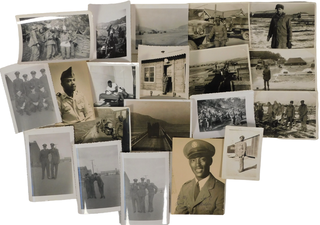
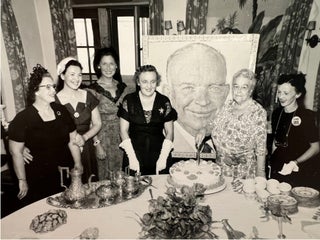
Photographs and printed ephemera documenting Prince Hall–affiliated fraternal organizations in the 1950s establish a record of African American civic, ritual, and social life during segregation, when Black institutions operated as central structures for leadership, mutual aid, and public identity. The archive identifies members of the Prince Hall Shriners and the Daughters of Isis in formal regalia and organized settings across Detroit, Atlantic City, and Pittsburgh, situating these organizations within broader networks of African American middle class life and associational culture. The materials support research into Black fraternal history, gendered organizational roles, and the development of parallel institutional systems in response to exclusion from white Masonic orders.Archive consists of eight pieces, including seven original black and white silver gelatin photographs ranging in size from approximately 3.5 x 3.5 inches to 8 x 10 inches, and one printed banquet program for an event held at the Mystic Shrine in Pittsburgh in 1952. Photographs depict both indoor and outdoor scenes, including group portraits of African American men wearing Shriner fezzes, sashes, and gloves, and women in white ceremonial gowns associated with the Daughters of Isis, arranged in formal formation within lodge interiors. One image captures a parade in Atlantic City, New Jersey, showing Shriners riding in a convertible as part of a public procession, while others show gatherings in Detroit beneath signage including a Budweiser banner, indicating event sponsorship or venue affiliation. Additional photographs present members assembled in structured groupings, emphasizing uniformity, hierarchy, and ceremonial order within the organizations.
The Prince Hall Shriners, formally known as the Ancient Egyptian Arabic Order Nobles of the Mystic Shrine, were established in 1893 as an extension of Prince Hall Masonry, which originated in the eighteenth century to provide African Americans access to Masonic practice denied in segregated white lodges. The Daughters of Isis, founded in 1910, functioned as a parallel auxiliary organization for women, participating in ritual, charity, and social programming. By the mid twentieth century, these groups played a visible role in public life through parades, civic events, and institutional gatherings, reinforcing community cohesion and leadership within segregated American society. Light creasing, corner wear, and minor surface abrasions across photographs; program well preserved; overall very good condition. This archive provides direct visual documentation of African American fraternal organization, ceremonial practice, and public presence in the pre–Civil Rights era.
Item #22258
Price: $885.00
See all items in African American Family & Community Life, Pennsylvania, African American Photography
See all items in African American History, American History by State, Photography, Archive
See all items in Pennsylvania, New Jersey
Suggested African American PhotographyBrowse All




Suggested PennsylvaniaBrowse All




Suggested African American HistoryBrowse All





Suggested PhotographyBrowse All