United States Corporate Influence and Saudi Petroleum Development in the Aramco Handbook 1968
First Edition
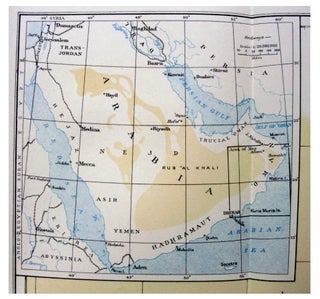
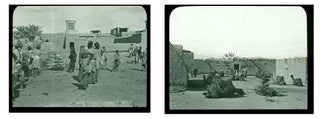
Arabian American Oil Company. Aramco Handbook: Oil and the Middle East, revised in 1968, documents the information system through which Aramco explained Saudi Arabia, Middle Eastern petroleum, and its own industrial operations to an English-language readership. Published while the company remained owned by four American oil corporations, the handbook combines petroleum geology, corporate history, political geography, and cultural instruction into a unified account of Saudi modernization under oil development. Its organization reveals how Aramco presented itself as both an industrial enterprise and an interpreter of Saudi society, using maps, photographs, diagrams, historical narratives, and rules of social conduct to prepare foreign personnel for work in the Kingdom. The volume provides primary-source evidence for research into United States–Saudi relations, corporate communication, petroleum infrastructure, expatriate labor, and the production of cultural knowledge within a multinational oil concession. Saudi acquisition of Aramco began during the following decade and reached full government ownership in 1980, placing this edition before the company’s transition to Saudi control.Arabian American Oil Company. Aramco Handbook: Oil and the Middle East. Dhahran, Saudi Arabia: Arabian American Oil Company, July 1, 1968. Revised edition. Printed in Haarlem, Netherlands, by Joh. Enschedé en Zonen. 276 pages. Profusely illustrated with color maps, black-and-white photographs, and diagrams. Original red cloth stamped in gilt and black; no dust jacket noted. 4to. The handbook is divided into five principal sections addressing the historical background of Saudi Arabia and the Middle East, the development of the regional petroleum industry, the Aramco venture, Saudi government and society, and Arab culture and customs. A tribal map identifies numerous communities across the Arabian Peninsula, including al-Mutair and al-Murrah, while a diagrammatic map of the “Conquest of Najd” traces Ibn Saud’s military expansion through arrows and battle annotations. Petroleum sections explain drilling, refining, transportation, and export infrastructure, including the Trans-Arabian Pipeline, illustrated by parallel lengths of pipe extending across open terrain and accompanied by discussion of the decision to construct substantial portions above ground. Photographic essays show communal dining, urban and industrial environments, and other aspects of public life. The “Social Etiquette” section introduces such greetings as as-salāmu ʿalaykum and kayf ḥālak, presenting cultural instruction as part of the company’s management of encounters between expatriate employees and Saudi residents. Bibliographic records confirm the 1968 Dhahran edition as an extensively illustrated corporate reference work on petroleum and the Middle East.
The handbook’s research value lies partly in the tension between the breadth of its documentation and the institutional perspective governing its interpretation. Its maps and photographs preserve substantial information about infrastructure, geography, labor, social practice, and the physical expansion of the Saudi petroleum industry, while its text consistently casts Aramco as the principal agent joining Saudi Arabia to global markets. Cultural sections reduce complex regional and social differences to practical guidance for foreign employees, and historical narratives place political consolidation and oil development within a corporate account of orderly progress. The volume should therefore be read both as a reference source and as evidence of how an American-owned concession represented its authority during a consequential phase of Saudi economic transformation. Light rubbing affects the boards, with slight fraying at the spine ends and minor handling wear to the text-block edges; interior clean and binding sound. Very good. A detailed corporate record of the maps, infrastructure, historical narratives, and cultural instruction through which Aramco explained—and justified—its place in Saudi Arabia’s petroleum economy.
Item #22549
Price: $225.00
See all items in Environment & Resources, Arabia
See all items in International & Global Culture, Labor, Environment & Industry, Science, Medicine & Technology, World History by Geography
See all items by Aramco
See all items in Arabia
Suggested ArabiaBrowse All


Suggested World History by GeographyBrowse All