Panama Canal and Indigenous Panama Photograph Archive Documenting Engineering Expansion and Native Communities in Early Twentieth Century Central America
Photograph
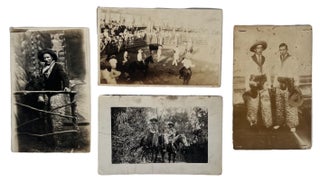
Archive of photographs documenting the Panama Canal and Indigenous communities in Panama in the early twentieth century, ranging from the industrial landscape of the canal's construction and operation to the daily lives of Indigenous Panamanian peoples. The photographs reflect two intertwined yet often contrasting aspects of Panamanian history: the rise of industrial imperialism and the endurance of Indigenous culture. Archive of 33 silver gelatin photographs. Each measure between 4.5" x 2.5" to 3.5" x 2.25".The series prominently features engineering achievements along the canal route. Images include multiple angles of locks and lift bridges, such as the Miraflores, Pedro Miguel, and Gatun Locks, as well as steamships and freighters navigating through the canal and moored along its edges. Several views capture drawbridges in operation, mechanical infrastructures like lock control houses, and long, rail-lined chambers used to elevate ships across Panama’s central isthmus. A few aerial or elevated shots emphasize the canal’s monumental scale, revealing vast water channels and industrial zones carved through jungle terrain. A second subset of photographs focuses on the Welland Ship Canal in Ontario, Canada, suggesting a comparative or thematic link between North American waterway engineering and the Panama Canal project—possibly compiled by a traveler, engineer, or canal enthusiast.
In contrast, the ethnographic photographs document Indigenous Panamanian groups—most likely Guna (Kuna) and Emberá–Wounaan peoples—living in thatched-roof villages, dressed in traditional textiles, body paint, and adornments. Several portraits show children and adults standing in front of woven bamboo huts, while others portray groups in ceremonial or communal settings. The camera’s perspective suggests a Western, possibly touristic or anthropological gaze, reflecting the era’s colonial attitudes toward Indigenous populations. The Panama Canal, completed in 1914 under U.S. control after a failed French attempt, was one of the most ambitious engineering projects of the 20th century. It transformed global maritime trade by connecting the Atlantic and Pacific Oceans through Central America. The canal’s construction required the displacement of communities, massive deforestation, and the recruitment of tens of thousands of laborers, primarily from the Caribbean, who worked under harsh and segregated conditions.
Indigenous populations in the canal zone and surrounding regions were deeply affected by this transformation. Their lands were often appropriated for canal infrastructure, military zones, or settler expansion. Cultural disruptions, ecological degradation, and restricted access to traditional territories became ongoing challenges. At the same time, Indigenous communities—especially the Guna—resisted assimilation and maintained distinct cultural practices, leading to moments of organized resistance like the 1925 Guna Revolution, which asserted political autonomy in the face of Panamanian and U.S. pressures. This archive preserves a multifaceted visual history of Panama at a time of profound transition. The industrial photographs document the ambitions and outcomes of a modern imperial project, while the ethnographic images capture Indigenous identities that persisted despite external pressures. Together, they offer insight into the tensions between modernization and tradition, progress and displacement—narratives that continue to shape Panama’s national story today.
Item #21783
Price: $485.00
See all items in Latino Community & Immigration, Mexico, South & Central America
See all items in American History & Americana, Chicano & Latin American History, Indigenous Peoples, International & Global Culture, Photography
See all items by Panama Canal Indigenous Life
See all items in Panama
Suggested Latino Community & ImmigrationBrowse All


Suggested Mexico, South & Central AmericaBrowse All


Suggested Chicano & Latin American HistoryBrowse All




Suggested International & Global CultureBrowse All