

Atomic Bomb and World War II Morris R. Jeppson Autograph Letter Detailing Hiroshima Fuzing System and Meeting with J. Robert Oppenheimer
Manuscripts & Autographs
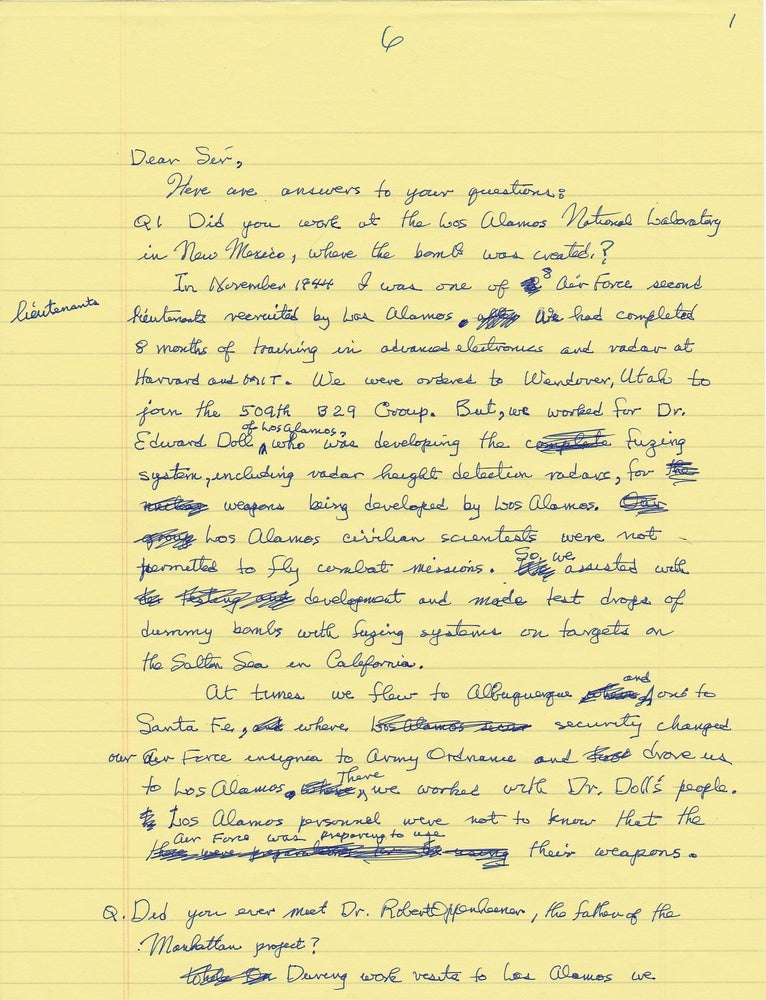
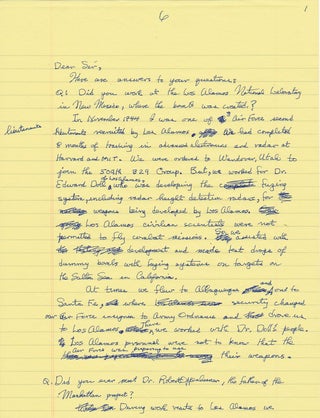
Jeppson, Morris R. Autograph Letter Signed, written after World War II, a first person technical and eyewitness account by the weapons officer of the Enola Gay, the B 29 aircraft that dropped the first atomic bomb on Hiroshima on 6 August 1945. As one of eight Army Air Forces second lieutenants recruited to support Los Alamos weapons development, Jeppson occupied a rare operational position linking laboratory science to combat deployment. In the present two page letter, written entirely in his hand in question and answer format, he explains his recruitment after advanced electronics and radar training at Harvard and MIT and his assignment to the 509th Bomb Group at Wendover, Utah. He describes working under Dr. Edward Doll of Los Alamos on the bomb’s fuzing system, including radar height detection, noting that “Los Alamos civilian scientists were not permitted to fly combat missions,” and recounts test drops of dummy bombs over the Salton Sea. His narrative situates him among the very small circle beyond senior scientists who understood the weapon’s intended use, as he was responsible for arming the fuzing system inside the bomb bay shortly before release over Hiroshima.Jeppson, Morris R. Autograph Letter Signed. No place, no date. Two pages on yellow lined paper, written in ink, signed “Sincerely, Morris R. Jeppson.”
In response to a question about J. Robert Oppenheimer, Jeppson recounts a May 1945 flight in which “The sole passenger was Dr. Oppenheimer. This very gracious man was smiling to visit with me, and he answered my questions about where I should attend graduate school in nuclear physics after the war,” recommending the University of California, Berkeley. He emphasizes the strict compartmentalization of the Manhattan Project: “Because of very tight security restrictions, neither of us ever mentioned nuclear weapons.” The letter provides granular insight into the operational secrecy of the project, the integration of military officers into laboratory development, and the transition from experimental design to battlefield use at the close of World War II. Numerous corrections and annotations appear throughout, reflecting careful retrospective clarification. Paper clean and fully legible, signature strong. Overall condition: excellent.
Item #14389
Price: $1,250.00
See all items in Utah, Cold War & Nuclear History, World War II, Science
See all items in American History by State, Military & War, Science, Medicine & Technology, Autographs, Manuscripts & Letters
See all items by Morris Jeppson Hiroshima Atomic Bomb Mission
See all items in Utah
Suggested World War IIBrowse All




Suggested ScienceBrowse All

Suggested UtahBrowse All




Suggested American History by StateBrowse All