Atomic Bombing of Hiroshima and World War II Memory: Morris R. Jeppson Autograph Letter Explaining the Hiroshima Mission
Manuscripts & Autographs
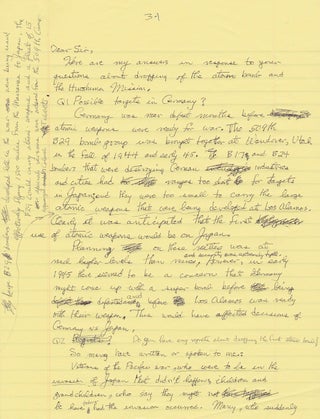
Jeppson, Morris R. Autograph letter discussing the Hiroshima atomic bombing written by the weapons test officer aboard the B 29 Enola Gay, the aircraft that delivered the first atomic bomb used in warfare on 6 August 1945. Morris Jeppson served as the officer responsible for arming the uranium bomb known as “Little Boy” during the mission, inserting the firing plug that activated the weapon shortly before the aircraft reached its target. His later correspondence addressing questions about the bombing provides firsthand testimony concerning the strategic context of the mission and the reasoning expressed by participants in the decades following World War II.Jeppson, Morris R. Autograph Letter Signed. Two pages written on yellow lined paper. In the letter Jeppson responds to written questions concerning the atomic bombing and the circumstances surrounding the Hiroshima mission, recording both the questions and answers in his own hand with numerous corrections and annotations. Addressing the question of whether atomic weapons might have been used against Germany, Jeppson explains: “Germany was near defeat months before atomic weapons were ready for war. The 509th B29 Bomb Group was brought together at Wendover, Utah in the fall of 1944 and early 1945… B17 and B23 bombers that were destroying German industries and cities had ranges too short for targets in Japan and they were too small to carry the large atomic weapons that were being developed at Los Alamos.” He continues by describing the strategic role of the B 29 aircraft and the planning surrounding the Pacific theater, noting that “clearly it was anticipated that the first use of atomic bombs would be on Japan in the Pacific War,” while also recalling wartime concern that Germany might develop a similar weapon before its defeat.
In response to a question about regret concerning the atomic bombing, Jeppson writes that many correspondents had contacted him in later years reflecting on the consequences of the war’s end: “Veterans of the War, who were to be in the invasion of Japan, AN INVASION THAT DIDN'T HAPPEN. Children and grandchildren who say they might not be here today had the invasion occurred… Many in Japan today are alive because the war ended.” He concludes that while there is “sorrow for those killed and injured by the two atomic bombings… the war ended quickly. A worse future didn't happen.” The letter is signed “Morris R. Jeppson.” Correspondence of this kind forms part of the broader historical record through which participants in the Hiroshima mission addressed public debate over the atomic bomb during the decades following World War II. Light handling wear with minor corrections visible in the manuscript text; overall excellent condition. A detailed firsthand statement by the officer who armed the atomic bomb during the Hiroshima mission.
Item #14387
Price: $900.00
See all items in Utah, Cold War & Nuclear History, World War II
See all items in American History by State, Military & War, Autographs, Manuscripts & Letters
See all items by Morris Jeppson
See all items in Utah
Suggested World War IIBrowse All




Suggested Cold War & Nuclear HistoryBrowse All


Suggested UtahBrowse All



Suggested Military & WarBrowse All