The Sioux Nation and the Black Hills: Supreme Court Brief Signed by Alexander Porter Morse, Attorney in Plessy v. Ferguson, 1896
Book
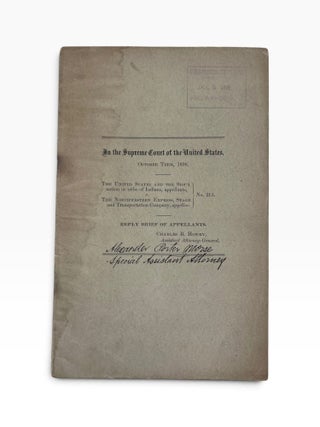
HOWRY, Charles B., and Alexander Porter MORSE, counsel. “The United States and the Sioux Nation or Tribe of Indians, Appellants, v. The Northwestern Express, Stage and Transportation Company, Appellee. Reply Brief of Appellants,” 1896. Supreme Court of the United States, October Term, No. 213. 6 x 9 inches, 16 pp. A brief in a case arising from the loss of four horses and their harness on a stage route connecting Bismarck with Deadwood and the Black Hills, partly through the Great Sioux Reservation. The transportation company sought compensation under the Indian Depredation Act of 1891, which allowed judgments against Native nations to be charged to tribal annuities and other funds, including proceeds from land sales. Arguing for the United States and the Sioux Nation, counsel challenged the company’s eligibility to recover; the Supreme Court ruled against them and upheld a $750 award. The case followed the federal seizure of the Black Hills in 1877 and documents a legal system through which Native resources could be used to compensate businesses operating on routes into contested territory. It did not itself decide ownership of the Black Hills.The Supreme Court’s ruling established that corporations could seek compensation under the Indian Depredation Act, extending access to a claims system that could charge judgments against tribal annuities and land-sale funds. The decision came less than twenty years after the federal seizure of the Black Hills, as transportation companies served the growing settlements and mining economy on former Sioux treaty land. It documents how federal courts weighed corporate property claims against the financial resources of Native nations during westward expansion.
The brief argues that the company had not established the citizenship required to bring its claim, citing decisions on state and federal citizenship including “Scott v. Sandford” and “United States v. Cruikshank.” Morse, a former Confederate officer, had represented Judge John H. Ferguson earlier that year in “Plessy v. Ferguson,” defending Louisiana’s racial segregation law before the Supreme Court. Signed by Alexander Porter Morse, signature appears in manuscript on the front wrapper beneath Howry’s printed name. Supreme Court office stamp dated December 5, 1896, two days before the case was submitted. Gray printed wrappers, stapled. Wrappers toned and stained with a small tear at the spine; staining to the upper margins of the photographed leaves. Overall in good condition.
Item #24089
Price: $750.00
See all items in Western Americana, North Dakota, Native American, Law & Public Policy
See all items in American History & Americana, American History by State, Indigenous Peoples, Law, Incarceration & Public Policy
See all items by Sioux Indigenous Land Rights
See all items in North Dakatoa
Suggested Native AmericanBrowse All





Suggested Western AmericanaBrowse All



Suggested North DakotaBrowse All
Suggested Indigenous PeoplesBrowse All