German Colonial China and Military in Tsingtao and Northern China during the Boxer Era Photo Archive, 1900-1910s
Photograph
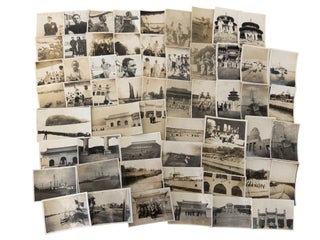
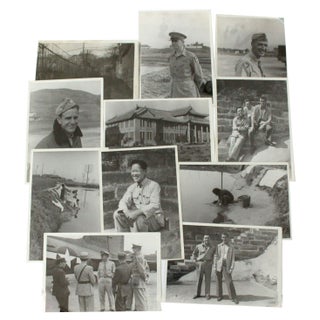
German colonial northern China photo archive, circa 1900 to 1910, documenting foreign military presence, Chinese commercial and social life, and the unequal encounters produced by European imperial expansion in the years surrounding the Boxer Rebellion. German occupation of Kiautschou Bay began in 1897, followed by the 1898 lease that placed the territory around Tsingtao under German control for 99 years and established the port as an Imperial German naval and commercial base. The photographs move between colonial military spectacle and less formal encounters as cavalry formations and Chinese prisoners appear alongside merchants, transport, rural scenes, and a European man repeatedly photographed wearing Chinese garments among Chinese men. German manuscript captions identifying Tsingtao and locations in Manchuria connect the group to a German speaking observer traveling through a northern China increasingly shaped by foreign military intervention.Photo archive of 12 silver gelatin photographs, approximately 3 x 4 inches each, northern China, including Tsingtao and Manchuria, circa 1900 to 1910. Several photographs depict a European man among Chinese men, wearing a long Chinese robe and cap in posed portraits outside a masonry building; in one he stands between two Chinese men similarly dressed, while another records a larger group in which Chinese and European subjects wear combinations of local and Western clothing. Other images show a mounted officer passing ranks of uniformed troops carrying standards; groups gathered around loaded wagons or carts; horsemen and spectators assembled across open ground; and broad views of people and animals distributed across a field. Two particularly stark photographs show Chinese men restrained individually against upright wooden stakes in an open landscape, their bodies separated at regular intervals along what appears to be a shoreline or field. Some photos with Manuscript German captions on the versos reference to Tsingtao and Manchuria.
Germany's presence at Tsingtao belonged to the larger division of Chinese territory into foreign concessions and spheres of influence at the end of the nineteenth century. The Imperial German Navy administered Kiautschou and developed Tsingtao as a planned colonial city and naval base, including residential segregation between European and Chinese populations. That colonial project intersected directly with the violence of the Boxer Rebellion in 1900. After the killing of German minister Clemens von Ketteler in Beijing, Germany dispatched approximately 20,000 troops to China; although the foreign legations had already been relieved when much of the German force arrived, German and other international troops subsequently conducted punitive expeditions in which suspected Boxers were executed and villages were looted and burned, operations that continued until the Boxer Protocol of September 1901. The photographs of bound prisoners therefore belong to a period in which execution and punitive violence formed a documented component of foreign intervention, although the absence of a securely deciphered caption prevents assigning these particular scenes to a specific campaign. The images of a European participant adopting Chinese clothing present another dimension of the colonial encounter, recording personal appropriation and performance of local dress within the same photographic record that encompasses military formations, prisoners, commerce, transportation, and everyday contact. Light surface wear, occasional creasing, toning, and fading; manuscript verso captions remain substantially legible. Overall in good condition. A German vernacular photographic record of northern China during the era of the Boxer intervention and Kiautschou colonial rule, preserving military power, coercion, commerce, and informal cross cultural encounters within the same small format archive.
Item #23886
Price: $1,850.00
See all items in Imperialism & Colonialism, Imperialism & Colonialism, Other (Military), China
See all items in International & Global Culture, Military & War, World History by Geography
See all items by German Colonial China Boxer Rebellion
See all items in China
Suggested Other (Military)Browse All





Suggested ChinaBrowse All



Suggested World History by GeographyBrowse All