Chinese Medicine Illustrated woodblock Bencao Congxin Plants, Minerals, Animals, and Medicinal Substances in Ten Thread Bound Books, 1913 Edition
Archive
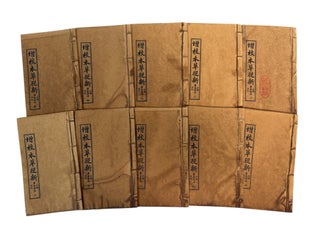
Chinese materia medica in ten illustrated thread bound booklets, Shanghai, 1913 illustrated woodblock reprint of the 18th century text, Wu Yiluo’s 吳儀洛 Qing pharmacological work Bencao Congxin 本草從新 in an extensively illustrated format that organizes medicinal substances through their sources, properties, therapeutic actions, preparation, and application. Wu completed the original work in 1757 after decades of medical study and practice, explicitly describing it as a revision of Wang Ang’s 汪昂 Bencao Beiyao 本草備要 in which he retained roughly half of the earlier text while revising and augmenting the remainder from older literature and his own experience. The present woodblock Republican era edition translates that textual pharmacology into a compact illustrated handbook: herbs appear with their leaves and roots exposed, trees are differentiated by growth and bark, mineral and animal substances are rendered as recognizable specimens, and medicinal fish are individually drawn above instructions for their therapeutic use.Wu Yiluo 吳儀洛. 增校本草從新, Zengjiao Bencao Congxin, “Newly Augmented and Collated Materia Medica from the New.” Shanghai: 上海廣益書局, Shanghai Guangyi Book Bureau, 中華民國二年, 1913. Ten Chinese thread bound illustrated booklets, approximately 4.5" x 8", printed in Chinese and illustrated throughout, with individual wrappers numbered sequentially. The title leaf reads 增校本草從新, Zengjiao Bencao Congxin, 中華民國二年, “Second Year of the Republic of China,” and 上海廣益書局印行, “Printed and Issued by Shanghai Guangyi Book Bureau.” The contents follow the pharmacological organization of Bencao Congxin, whose eighteen juan proceed through divisions devoted to grasses and herbs, trees, fruits, vegetables, grains, metals and stones, water, fire and earth, birds and beasts, insects, fish, scales and shells, and substances derived from the human body.
[1] Herbal medicines. Illustrated entries identify individual medicinal plants through drawings of roots, stems, leaves, and flowers, accompanied by dense columns describing their properties and uses.
[2] Herbal medicines. Further botanical entries pair plants of similar therapeutic or classificatory position, allowing differences in root formation, foliage, and growth to be read directly beside their written descriptions.
[3] Herbal medicines. Drawings include 天南星, Tiannanxing, and other medicinal roots and herbs, with the underground portion of the plant deliberately exposed for identification.
[4] Trees and woody drugs. Illustrated entries depict 柏, cypress, and related trees and plant products, moving from whole tree forms to the medicinal substances obtained from them.
[5] Bamboo and woody substances. Bamboo, roots, bark, and other plant materials are rendered separately above discussions of their medical properties and applications.
[6] Vegetable and plant drugs. Rows of botanical specimens continue the work’s practical identification of medicinal plants, each drawing placed directly above its corresponding entry.
[7] Mineral and prepared substances. Entries depict powders, stones, mineral formations, and processed medicinal substances, extending the visual taxonomy beyond the botanical materia medica.
[8] Prepared and manufactured medicines. Illustrations of containers, implements, blocks, powders, and other prepared substances accompany directions and pharmacological discussion, recording medicines whose identity depended upon processing as well as natural origin.
[9] Animal and aquatic drugs. Illustrated animal substances broaden the pharmacopoeia beyond plants and minerals into medicines obtained from living creatures.
[10] Fish and aquatic materia medica. Five individually rendered fish appear above separate columns of text describing their medicinal properties and applications, a compact example of the work’s combination of natural history, visual identification, and therapeutics.
Bencao Congxin belongs to the Qing tradition of revising earlier materia medica into increasingly practical manuals for clinical use. Wu’s own preface places the book after Li Shizhen’s Bencao Gangmu, Miao Xiyong’s pharmacological writings, and Wang Ang’s Bencao Beiyao, explaining that he found Wang’s compilation concise and widely useful but sought to correct inherited errors and incorporate knowledge derived from medical experience. The resulting work was organized into eighteen juan and classified drugs across the plant, mineral, animal, aquatic, and human worlds; its opening discussion interprets medicines through the paired categories of qi and flavor, including cold, heat, warmth, coolness, sourness, bitterness, sweetness, pungency, saltiness, and blandness. This 1913 Shanghai edition shows that Qing materia medica remained active within the commercial medical print culture of the early Republic, while its abundant illustrations gave readers a visual means of moving between the written name of a drug, its physical source, and instructions for therapeutic use. Wrappers uniformly browned and mottled, with scattered staining, rubbing, edge wear, and wear to the thread bindings; interiors toned with occasional marginal staining and small edge faults, while text and illustrations remain strong and legible. Overall good condition. Ten compact volumes preserving the Republican era circulation of Qing pharmacology through a visual taxonomy in which medicinal plants, roots, trees, minerals, prepared substances, animals, and fish are identified beside instructions governing their properties and therapeutic use.
Item #23778
Price: $450.00
See all items in World Culture & Travel, World Religion & Philosophy, Medicine & Public Health, China
See all items in International & Global Culture, Science, Medicine & Technology, World History by Geography
See all items by Bencao Congxin Chinese Medicine
See all items in China
Suggested ChinaBrowse All




Suggested World History by GeographyBrowse All