Puerto Rico Slave Registration After the Moret Law Listing a 20 Year Old Enslaved Black Man, "Eugenio", 1872
Manuscript & Autographs
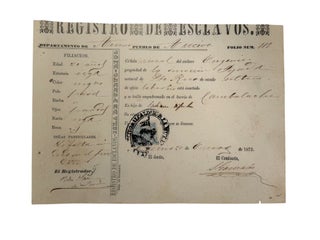
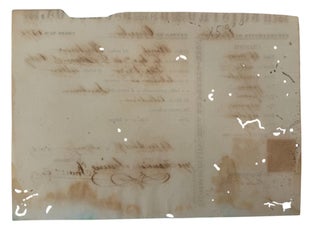
Puerto Rican slave registration document from January 1872, recording the legal status, ownership, labor, residence, parentage, and physical identification of Eugenio, a twenty year old enslaved Black man in Arecibo during the final fourteen months of slavery on the island. The cédula was issued within the registration system expanded following the Moret Law of 1870, which freed specified categories of enslaved people while leaving young adults such as Eugenio in bondage and led to the preparation of Puerto Rico's central slave register. Surviving 1872 schedules record the same categories present here, including name, origin, residence, parents, marital status, occupation, age, physical description, and enslaver.Registro de Esclavos, Isla de Puerto Rico. Arecibo, Puerto Rico, January 20, 1872. Single printed and manuscript slave registration cédula, folio no. 119. The document identifies “Eugenio” as twenty years old, “Color negro,” single, and employed “de oficio labrador,” placing agricultural labor directly within his official identification. He is recorded as a native of Puerto Rico and registered in the barrio of Cambalache. His ownership entry appears to read “propiedad de la sucesión …,” indicating ownership by an estate or succession, although the following name is difficult to establish confidently from the manuscript hand. The “Filiacion” column records his stature as “regular,” black hair, sparse beard, brown eyes, a regular nose, and additional identifying information; under “Señas particulares,” a manuscript notation appears to record a defect involving the right foot, though the exact wording is partially unclear. The document carries the signatures or attestations of the “Registrador” and “El Comisario,” together with a fiscal stamp heavily cancelled by an official circular handstamp. The verso bears additional official stamps and manuscript markings associated with the document's administrative use.
Eugenio was registered at a moment when Spanish policy had begun dismantling slavery selectively while continuing to document and regulate those excluded from immediate freedom. The Moret Law granted freedom to people over sixty, enslaved people belonging to the state, and children born after September 17, 1868; at twenty, Eugenio fell outside its principal age based provisions. Puerto Rico's surviving 1872 Registro Central de Esclavos is preserved in eight rolls of National Archives microfilm, and comparable original Arecibo cédulas survive institutionally, including a January 1872 folio at the University of Florida that likewise records an enslaved man's age, physical description, ownership, and official signatures. On March 22, 1873, slavery was abolished in Puerto Rico, terminating the legal status under which Eugenio had been entered on this form. Light toning and spotting, several small wormholes and minor edge losses; stamps, printed text, and principal manuscript entries remain legible. Overall good condition. An individually named record of how Spanish colonial authorities reduced Eugenio's legal status, agricultural occupation, ancestry, residence, and bodily characteristics to standardized identifying data during Puerto Rico's final full year of slavery.
Item #23796
Price: $850.00
See all items in Puerto Rico, Other (Chicano/Latino), Imperialism & Colonialism
See all items in American History by State, Chicano & Latin American History, International & Global Culture
See all items by Slavery Puerto Rico
See all items in Puerto Rico
Suggested Other (Chicano/Latino)Browse All





Suggested Puerto RicoBrowse All


Suggested American History by StateBrowse All